

Analytical Data
-
Gene name
WBSCR22
- Application
-
Alternative Names
HASJ4442 ; HUSSY 3; HUSSY3; PP3381 ; Uncharacterized methyltransferase WBSCR22; WBMT ; WBS22_HUMAN; WBSCR22; Williams Beuren candidate region putative methyltransferase; Williams Beuren syndrome chromosome region 22 Protein; Williams-Beuren syndrome chromosomal region 22 Protein
-
Species
Human
-
Source
E. coli
-
Tag
His tag N-Terminus
-
Purity
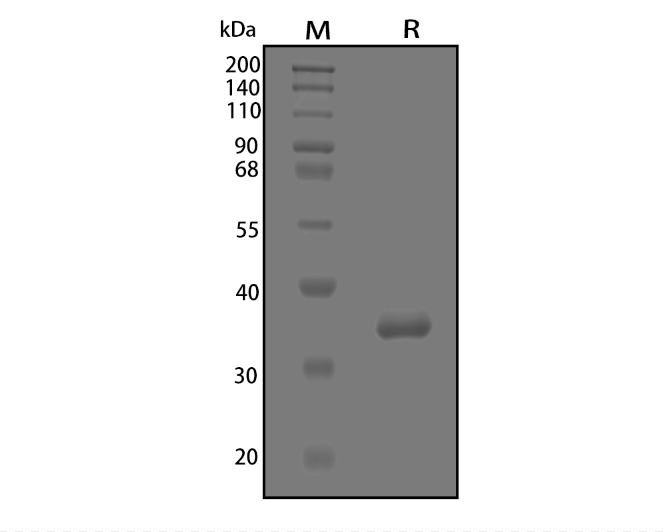
Greater than 90% as determined by SDS-PAGE.
-
Uniprot
O43709
-
Expression Region
1-281 aa
-
AA Sequence
MASRGRRPEH GGPPELFYDE TEARKYVRNS RMIDIQTRMA GRALELLYLP ENKPCYLLDI GCGTGLSGSY LSDEGHYWVG LDISPAMLDE AVDREIEGDL LLGDMGQGIP FKPGTFDGCI SISAVQWLCN ANKKSENPAK RLYCFFASLF SVLVRGSRAV LQLYPENSEQ LELITTQATK AGFSGGMVVD YPNSAKAKKF YLCLFSGPST FIPEGLSENQ DEVEPRESVF TNERFPLRMS RRGMVRKSRA WVLEKKERHR RQGREVRPDT QYTGRKRKPR F
-
Molecular Weight
31.8 kDa
-
Endotoxin
< 1.0 EU per μg protein as determined by the LAL method.
-
Form
Freeze-dried powder
-
Buffer formulation
PBS, pH7.4, containing 0.01% SKL, 1mM DTT, 5% Trehalose and Proclin300.
-
Reconstitution
Reconstitute in ddH2O to a concentration of 0.1-0.5 mg/mL. Do not vortex.
- Customization
-
Stability Test
The thermal stability is described by the loss rate. The loss rate was determined by accelerated thermal degradation test, that is, incubate the protein at 37℃ for 48h, and no obvious degradation and precipitation were observed. The loss rate isless than 8% within the expiration date under appropriate storage condition.
-
Storage & Shelf Life
Samples are stable for up to twelve months from date of receipt at -20℃ to -80℃. Store it under sterile conditions at -20℃ to -80℃. It is recommended that the protein be aliquoted for optimal storage. Avoid repeated freeze-thaw cycles.
-
Shipping
In general, recombinant proteins are supplied as lyophilized powder and shipped at ambient temperature. For bulk packages, the proteins are provided as frozen liquid and shipped with blue ice, unless otherwise requested by the customer.
Quality inspection process

Related Products
Protein Description
WBSCR22, a protein associated with Williams-Beuren syndrome (WBS), has garnered attention in the field of genetic research due to its potential roles in developmental processes and cellular functions. Williams-Beuren syndrome is a complex genetic disorder characterized by cardiovascular anomalies, cognitive impairments, and distinctive facial features, resulting from a deletion of genetic material on chromosome 7. The WBSCR22 gene is part of this deleted region and is believed to contribute to the syndrome's phenotypic manifestations. Research into WBSCR22 involves elucidating its structure, function, and the molecular pathways it influences. Understanding how WBSCR22 interacts with other proteins and regulates biological processes can provide insights into the mechanisms underlying WBS and similar genetic conditions. Moreover, investigating the potential therapeutic implications of modulating WBSCR22 activity may reveal novel strategies for managing developmental disorders. Overall, the study of WBSCR22 not only enhances our comprehension of Williams-Beuren syndrome but also expands our knowledge of gene function in human development and disease.







