MicroScale Thermophoresis (MST) Detection Service

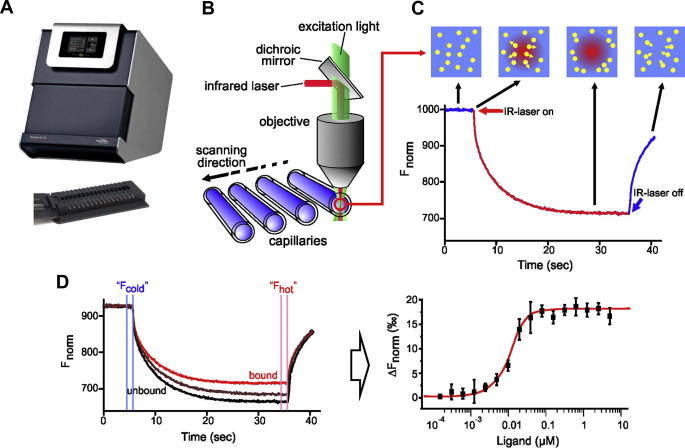
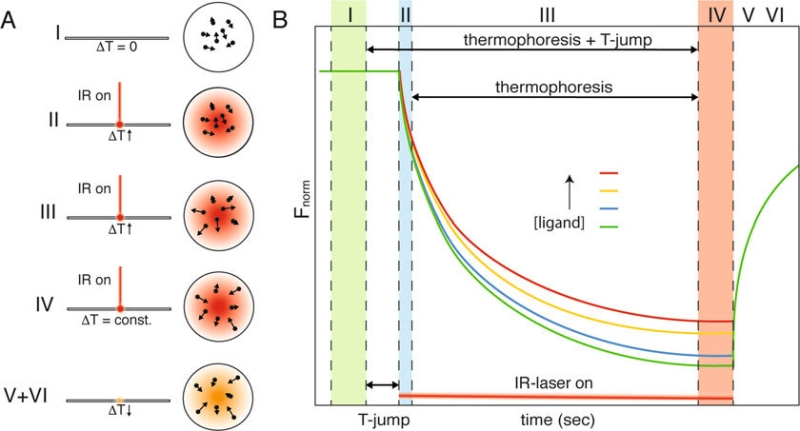
Microscale Thermophoresis (MST) is a technique for biomolecular interaction research by monitoring the migration behavior of biomolecules within a temperature gradient field. Based on fluorescent labeling, this technology precisely captures molecular movement variations induced by the thermophoretic effect, enabling highly sensitive quantitative analysis of binding affinity. MST establishes a localized temperature field in sample solutions via an infrared laser to characterize molecular interactions. During experiments, one molecule (e.g., a protein) is fluorescently labeled or fused with a GFP tag, then incubated with analyte molecules at serial concentrations in capillaries. Focused laser heating generates a temperature gradient across the irradiated area, driving directional molecular migration from high-temperature to low-temperature zones. The extent of migration is closely correlated with molecular mass, charge properties and intermolecular binding. By measuring fluorescent signals from labeled or intrinsically fluorescent molecules, the equilibrium dissociation constant Kd of molecular binding can be determined.
Detection Features

  • No immobilization required

    • Detection performed entirely in liquid-phase solution • No sensor chip immobilization required • Eliminates interference induced by surface effects • Preserves the native state of biomolecules

  • Minimal sample consumption

    • Ultra-low sample volume per test • Ideal for precious limited samples • Compatible with low-concentration analytes • Better controllable experimental costs

  • Rapid and efficient detection

    • Simple experimental preparation • Fast detection speed • Suitable for high-throughput screening • Short testing turnaround with rapid data delivery

  • Broad applicability

    • Protein-small molecule interaction • Protein-protein interaction • Compatible with nucleic acids, peptides and polysaccharides • Feasible for analysis of complex biological matrices

  • Tolerant of complex biological matrices

    • Compatible with serum and cell lysate samples • Enables analysis of crude samples and supernatants • Superior anti-interference performance • Minimal pre-treatment required

  • Precise affinity quantification

    • Output full binding curves for data visualization • Quantitatively calculate equilibrium dissociation constant (KD) • Covers an extensive affinity range from pM to mM • Stable and highly reproducible assay results

Service Advantage

Click to Customize
  • MicroScale Thermophoresis (MST) Instrument

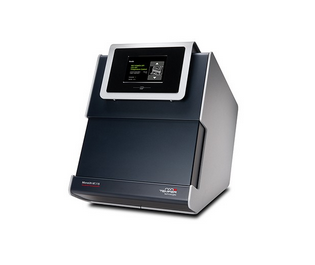
    This instrument is a straightforward, rapid device for precise quantitative analysis of biomolecular interactions. It measures molecular migration within microscopic temperature gradient fields and detects variations in molecular hydration shell, charge and molecular size. During MST assays, an infrared laser irradiates samples to generate a localized microscopic temperature gradient. The directional migration of molecules is monitored and quantified via covalently conjugated fluorescent dyes, fluorescent fusion proteins or intrinsic autofluorescence, enabling accurate characterization of intermolecular biomolecular binding interactions.

  • Library with over 30,000 recombinant proteins

    The protein library delivers broad systematic coverage of human and multi-species protein targets, including cytokines, receptors, enzymes, transcription factors and key signaling pathway nodes. This large-scale protein resource greatly lowers the barrier of target acquisition for early-stage projects, accelerating drug discovery and mechanistic research workflows.

  • Excellent compatibility with diverse sample types

    MST boasts outstanding compatibility with diverse sample matrices and is tolerant of detergents, serum, cell lysates and complex buffer formulations. Robust binding data can be obtained even with unpurified samples under near-native conditions.

  • Reliable data with high repeatability

    MST monitors thermophoretic movement of molecules within temperature gradients, delivering distinct signals with low background noise. Under standardized operating protocols, assays feature excellent reproducibility and batch-to-batch consistency, making the technique ideal for quantitative research and comparative analysis.

More related services

Click to Customize

Frequently Asked Questions

  • What results can MST generate? Can the KD value be obtained directly?

    MST routinely outputs binding curves, from which the dissociation constant (Kd) can be fitted to evaluate the binding affinity between biomolecules. For samples with distinct binding behavior and favorable signal-to-noise ratio, MST delivers reliable affinity data. It is also applicable for preliminary screening to qualitatively judge whether binding occurs.

  • What are the differences between MST and SPR (Surface Plasmon Resonance)? How to select the suitable technique?

    SPR is a solid-phase detection technique, featuring the capability to acquire kinetic parameters (ka/kd) and provide detailed resolution of binding processes. In contrast, MST operates in a fully liquid-phase system; it rapidly yields Kd values under near-native biological conditions, with superior matrix compatibility and far lower sample consumption. SPR is the ideal choice if clients require full kinetic parameters or intend to conduct precise comparative analysis of binding profiles across multiple antibodies. MST delivers higher efficiency for scenarios where rapid binding validation and affinity quantification are prioritized, especially when working with limited sample quantities or complex biological matrices.

  • Is fluorescent labeling required for MST? Will labeling affect protein activity?

    MST generally requires fluorescent labeling of one binding partner (proteins are the most commonly labeled target), or the use of samples with intrinsic autofluorescence or inherent tags. Labeling may alter the activity or conformation of certain proteins. Therefore, during experimental design, we adopt optimal labeling schemes and tag positions, and conduct preliminary tests to verify signal quality and binding tendency, minimizing interference risks introduced by labeling.

  • Can small molecules and compounds be tested via MST? Is DMSO compatible in the system?

    Yes. MST is highly suitable for verifying protein-small molecule binding, especially for primary screening and binding confirmation of candidate compounds. The system tolerates a certain proportion of DMSO. Nevertheless, consistent DMSO concentration across all serial dilution samples is recommended to minimize signal interference caused by solvent discrepancies. For highly hydrophobic compounds, we will propose optimized buffer formulations tailored to solubility characteristics.

If you have any questions, please contact us.

  • Name *

  • Tel *

  • Email *

  • Country *

  • Company *

  • Consultation Type *

  • Consultation content *

IPODIX Biotech Inc

2108 N ST, STE N
Sacramento, CA 95816, USA

For Product Information and Orders

sales@ipodix.com

For Business Collaboration

sales@ipodix.com

For CRO Services

sales@ipodix.com

For Technical Support

sales@ipodix.com
  • 50000+

    Recombinant Proteins

  • 100+

    Researchers

  • 100+

    Countries Served

  • ISO

    Certified Quality

Committed to Quality
Driven by Innovation

Learn More About US