Insect Cell Expression Service

Insect cell expression systems feature eukaryotic protein folding and post-translational modification capabilities alongside high expression efficiency, serving as a cost-effective solution for preparing complex recombinant proteins. This system enables proper disulfide bond formation and critical glycosylation modifications, making it suitable for expressing multi-domain proteins, membrane proteins, and proteins with strict conformational and functional requirements. Insect cell culture maintains stable conditions; proteins expressed by this system possess structures and functions closer to their native state, and the platform is widely applied in scientific research, vaccine development, protein functional research and other fields.
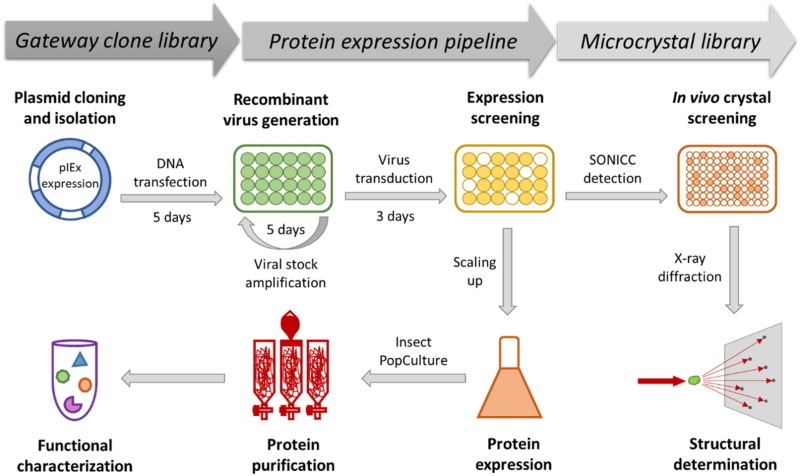
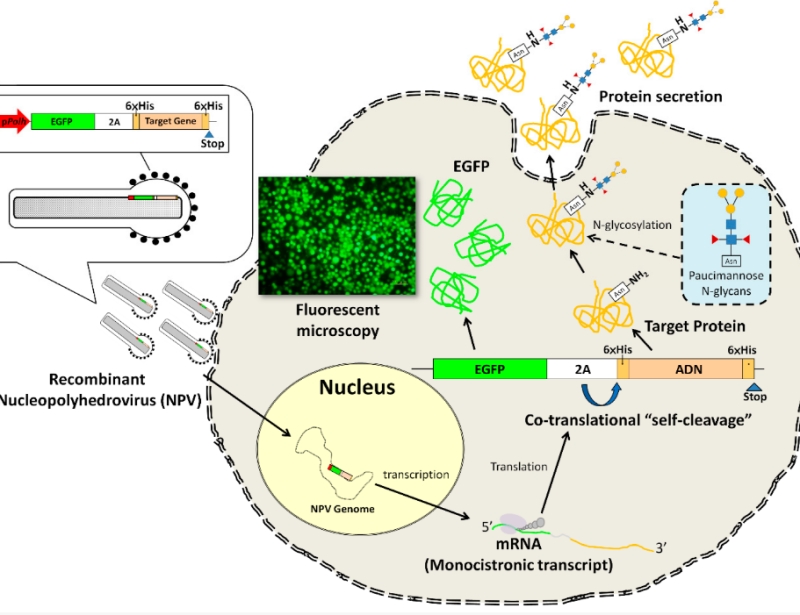
Service Workflow

  • 1 week

    Gene synthesis & vector construction

    • Leading codon optimization system • Analysis and optimization of rare codons, codon bias and other factors

    Deliverables:

    • Plasmid sequencing report

  • 2 weeks

    Baculovirus transfection

    • Virus packaging • Virus amplification • Multiple insect cell lines

  • 2 weeks

    Protein expression and purification

    • Small-scale fermentation culture • Expression condition optimization • Protein expression evaluation • Diverse protein purification methods

  • 1 week

    Customized services (optional)

    • Secondary purification • Tag cleavage • Endotoxin removal • Protein labeling • Activity assay • Protein analysis

  • 2 days

    Re-inspection, warehousing & delivery

    ・Deliver proteins that meet customized requirements ・Generate official COA reports via QC verification

    Deliverables:

    • Purified protein • Certificate of analysis (COA)

Extended services

We can expand supporting services to meet diverse project demands, including • Endotoxin removal service • Tag cleavage service • Protein labeling service • Protein affinity assay service • Protein mutagenesis service

Service Advantage

Click to Customize
  • Highly consistent eukaryotic modifications

    Insect Cell Expression System is equipped with full eukaryotic post-translational modifications (PTMs), including glycosylation, phosphorylation and other modifications. Compared with prokaryotic systems, insect cells can produce proteins with native-like modification patterns, which greatly improves the functional consistency and biological relevance of target proteins.

  • Near-native protein activity

    Insect cells possess complete protein folding & quality control machinery, which facilitates target proteins to form correct tertiary and quaternary structures. Proteins produced by this system exhibit near-native activity in functional assays such as receptor binding, enzymatic activity and signal transduction, making them suitable for functional and protein interaction studies.

  • Ideal for complex protein expression

    Insect cells have higher expression tolerance for large proteins, multi-domain proteins and certain membrane proteins. Combined with the Baculovirus Expression Vector System (BEVS), efficient and stable production of complex proteins can be achieved.

  • Compatible with various downstream applications

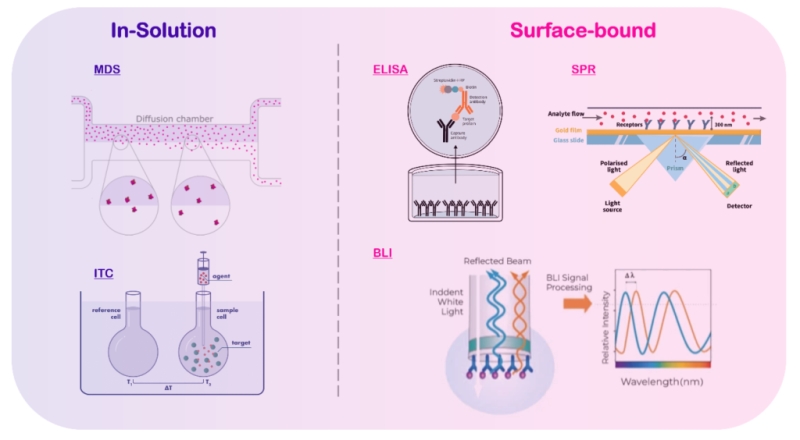
    Proteins expressed in insect cells exhibit outstanding conformation, activity and stability, and can be directly applied to SPR/BLI molecular interaction analysis, Cryo-EM structural research, antibody screening and functional assays. This effectively reduces the risk of experimental failures caused by poor protein quality in downstream workflows.

More related services

Click to Customize

Frequently Asked Questions

  • What is the insect cell expression system? Which proteins are suitable for expression with it?

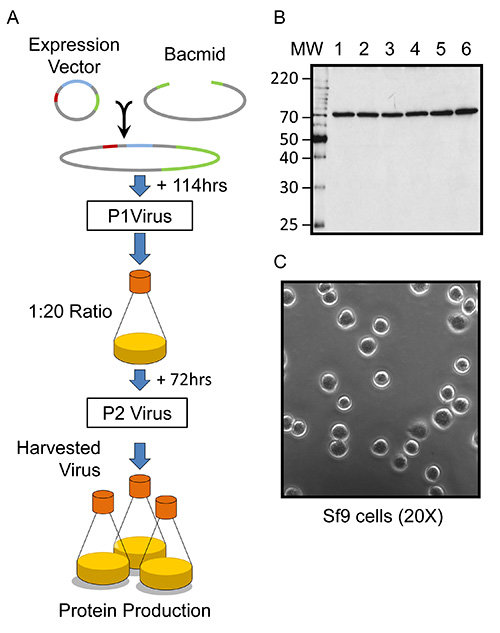
    The insect cell expression system generally refers to the Baculovirus Expression Vector System (BEVS), which achieves high-level expression of target proteins by infecting insect cells such as Sf9, Sf21 and High Five with baculoviruses. This system is highly suitable for expressing large proteins, multi-domain proteins, complex proteins, secreted proteins, viral proteins, certain membrane proteins and proteins with strict folding requirements. Compared with prokaryotic expression systems, insect cells provide an eukaryote-like folding environment, leading to higher expression success rates and better functional consistency of target proteins.

  • Can low expression yield in insect cells be optimized?

    Yes, the expression yield in insect cells is affected by multiple factors, including multiplicity of infection (MOI), infection timing, cell density, cell culture status, harvest window, and intrinsic protein stability. We routinely boost protein production by optimizing infection parameters and expression time windows. Meanwhile, we adjust tag design, construct layout and secretion expression strategies according to individual protein properties. For hard-to-express proteins, small-scale condition screening can rapidly identify optimal expression protocols to improve delivery success rate and overall efficiency.

  • Are proteins expressed from insect cells applicable to functional assays and antibody screening?

    Proteins expressed by insect cells generally possess favorable structural integrity and functional activity for most research applications, and are suitable for binding assays, antibody screening, immunoassays, structural studies, protein-protein interaction analysis and other experiments. However, if your project has specific requirements for glycosylation patterns (such as functions heavily dependent on native mammalian glycoforms), we recommend clarifying your downstream applications at the pre-sales stage. We will then evaluate whether a mammalian expression system is required to make the protein better match your end-use demands.

  • Can insect cell expression produce membrane proteins or multi-transmembrane proteins?

    Insect cell expression has unique advantages for membrane protein production, especially for certain membrane proteins, receptor proteins and viral envelope proteins. Nevertheless, membrane protein expression is inherently challenging; the success rate is closely linked to the number of transmembrane domains, construct design, expression formats (truncated/fusion variants) and purification workflows. We typically adopt a strategy of parallel small-scale construct screening to maximize the chance of identifying expressible, purifiable and stable constructs, thus elevating the overall project success rate.

If you have any questions, please contact us.

  • Name *

  • Tel *

  • Email *

  • Country *

  • Company *

  • Consultation Type *

  • Consultation content *

IPODIX Biotech Inc

2108 N ST, STE N
Sacramento, CA 95816, USA

For Product Information and Orders

sales@ipodix.com

For Business Collaboration

sales@ipodix.com

For CRO Services

sales@ipodix.com

For Technical Support

sales@ipodix.com
  • 50000+

    Recombinant Proteins

  • 100+

    Researchers

  • 100+

    Countries Served

  • ISO

    Certified Quality

Committed to Quality
Driven by Innovation

Learn More About US