

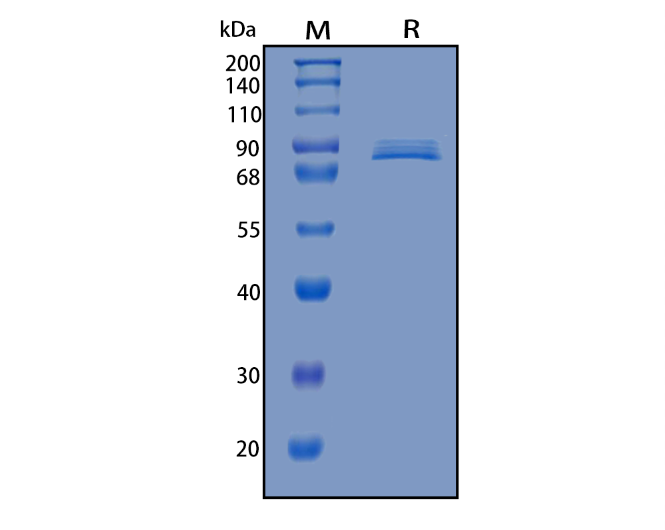
Analytical Data
-
Gene name
SNX4
- Application
-
Alternative Names
ATG24B; SNX 4; snx4; SNX4_HUMAN; Sorting nexin 4; Sorting nexin-4
-
Species
Human
-
Source
E. coli
-
Tag
His tag N-Terminus
-
Purity
Greater than 90% as determined by SDS-PAGE.
-
Uniprot
O95219
-
Expression Region
1-450 aa
-
AA Sequence
MEQAPPDPER QLQPAPLEPL GSPDAGLGAA VGKEAEGAGE ESSGVDTMTH NNFWLKKIEI SVSEAEKRTG RNAMNMQETY TAYLIETRSV EHTDGQSVLT DSLWRRYSEF ELLRSYLLVY YPHIVVPPLP EKRAEFVWHK LSADNMDPDF VERRRIGLEN FLLRIASHPI LCRDKIFYLF LTQEGNWKET VNETGFQLKA DSRLKALNAT FRVKNPDKRF TDLKHYSDEL QSVISHLLRV RARVADRLYG VYKVHGNYGR VFSEWSAIEK EMGDGLQSAG HHMDVYASSI DDILEDEEHY ADQLKEYLFY AEALRAVCRK HELMQYDLEM AAQDLASKKQ QCEELVTGTV RTFSLKGMTT KLFGQETPEQ REARIKVLEE QINEGEQQLK SKNLEGREFV KNAWADIERF KEQKNRDLKE ALISYAVMQI SMCKKGIQVW TNAKECFSKM
-
Molecular Weight
51.9 kDa
-
Endotoxin
< 1.0 EU per μg protein as determined by the LAL method.
-
Form
Freeze-dried powder
-
Buffer formulation
PBS, pH7.4, containing 0.01% SKL, 1mM DTT, 5% Trehalose and Proclin300.
-
Reconstitution
Reconstitute in ddH2O to a concentration of 0.1-0.5 mg/mL. Do not vortex.
- Customization
-
Stability Test
The thermal stability is described by the loss rate. The loss rate was determined by accelerated thermal degradation test, that is, incubate the protein at 37℃ for 48h, and no obvious degradation and precipitation were observed. The loss rate isless than 8% within the expiration date under appropriate storage condition.
-
Storage & Shelf Life
Samples are stable for up to twelve months from date of receipt at -20℃ to -80℃. Store it under sterile conditions at -20℃ to -80℃. It is recommended that the protein be aliquoted for optimal storage. Avoid repeated freeze-thaw cycles.
-
Shipping
In general, recombinant proteins are supplied as lyophilized powder and shipped at ambient temperature. For bulk packages, the proteins are provided as frozen liquid and shipped with blue ice, unless otherwise requested by the customer.
Quality inspection process

Related Products
Protein Description
SNX4 (Sorting Nexin 4) is a member of the sorting nexin family, which plays a crucial role in intracellular trafficking, specifically in the endosomal-lysosomal pathway. It is known to interact with various proteins involved in membrane dynamics and signaling processes. Research into SNX4 has gained attention due to its potential involvement in several cellular functions, including receptor recycling, protein sorting, and regulation of autophagy. Abnormalities in SNX4 have been implicated in various diseases, including neurodegenerative disorders and cancer, highlighting the importance of understanding its function and mechanisms. The study of recombinant SNX4 protein provides a valuable opportunity to elucidate its structural features, interaction partners, and biological roles. By generating and characterizing recombinant SNX4, researchers aim to investigate its involvement in endosomal trafficking and its effects on cellular homeostasis. This research could pave the way for developing therapeutic strategies targeting SNX4-related pathways, thus offering insights into new treatment options for diseases linked to its dysfunction.







