

Analytical Data
-
Gene name
DCI
- Application
-
Alternative Names
DCI;DCI;Enoyl-CoA delta isomerase 1. mitochondrial
-
Species
Human
-
Source
E. coli
-
Tag
His tag N-Terminus
-
Purity
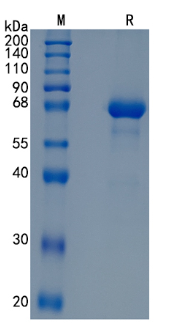
Greater than 90% as determined by SDS-PAGE.
-
Uniprot
P42126
-
Expression Region
42-302aa
-
AA Sequence
FGSQRVLVE PDAGAGVAVM KFKNPPVNSL SLEFLTELVI SLEKLENDKS FRGVILTSDR PGVFSAGLDL TEMCGRSPAH YAGYWKAVQE LWLRLYQSNL VLVSAINGAC PAGGCLVALT CDYRILADNP RYCIGLNETQ LGIIAPFWLK DTLENTIGHR AAERALQLGL LFPPAEALQV GIVDQVVPEE QVQSTALSAI AQWMAIPDHA RQLTKAMMRK ATASRLVTQR DADVQNFVSF ISKDSIQKSL QMYLERLKEE KG
-
Molecular Weight
32.8 kDa
-
Endotoxin
< 1.0 EU per μg protein as determined by the LAL method.
-
Form
Freeze-dried powder
-
Buffer formulation
PBS, pH7.4, containing 0.01% SKL, 1mM DTT, 5% Trehalose and Proclin300.
-
Reconstitution
Reconstitute in ddH2O to a concentration of 0.1-0.5 mg/mL. Do not vortex.
- Customization
-
Stability Test
The thermal stability is described by the loss rate. The loss rate was determined by accelerated thermal degradation test, that is, incubate the protein at 37℃ for 48h, and no obvious degradation and precipitation were observed. The loss rate isless than 8% within the expiration date under appropriate storage condition.
-
Storage & Shelf Life
Samples are stable for up to twelve months from date of receipt at -20℃ to -80℃. Store it under sterile conditions at -20℃ to -80℃. It is recommended that the protein be aliquoted for optimal storage. Avoid repeated freeze-thaw cycles.
-
Shipping
In general, recombinant proteins are supplied as lyophilized powder and shipped at ambient temperature. For bulk packages, the proteins are provided as frozen liquid and shipped with blue ice, unless otherwise requested by the customer.
Quality inspection process

Related Products
Protein Description
DCI (Dipeptide Cyclization Intermediate) recombinant proteins are an area of research that bridges the fields of protein engineering and therapeutic development. The study of DCI proteins is essential due to their unique folding patterns and structural configurations, which can enhance stability and functionality. These proteins are often used in biotechnology and pharmaceutical applications, where their ability to mimic natural peptides or proteins can lead to the development of novel drug candidates or therapeutic agents. Researchers are particularly interested in modifying these proteins to improve their bioavailability and reduce immunogenicity, which is critical in therapeutic settings. The recombinant production of DCI proteins allows for high yield and purity, enabling extensive studies on their biological activities and interactions. This research has significant implications for the development of targeted therapies, including those for cancer, autoimmune diseases, and various metabolic disorders. Furthermore, advancements in techniques such as CRISPR and synthetic biology have accelerated the ability to engineer these proteins, pushing the boundaries of what can be achieved in personalized medicine and advancing our understanding of protein function in complex biological systems. Overall, DCI recombinant protein research is a rapidly evolving field with the potential to transform medical therapies and enhance our understanding of molecular biology.







