

Analytical Data
-
Gene name
RRAGC
- Application
-
Alternative Names
RRAGC;Ras-related GTP-binding Protein C
-
Species
Human
-
Source
E. coli
-
Tag
His tag N-Terminus
-
Purity
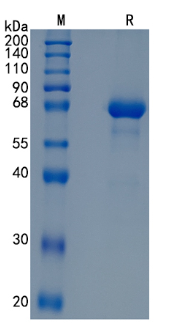
Greater than 90% as determined by SDS-PAGE.
-
Uniprot
Q9HB90
-
Expression Region
1-399aa
-
AA Sequence
MGSSHHHHHH SSGLVPRGSH MGSHMSLQYG AEETPLAGSY GAADSFPKDF GYGVEEEEEE AAAAGGGVGA GAGGGCGPGG ADSSKPRILL MGLRRSGKSS IQKVVFHKMS PNETLFLEST NKIYKDDISN SSFVNFQIWD FPGQMDFFDP TFDYEMIFRG TGALIYVIDA QDDYMEALTR LHITVSKAYK VNPDMNFEVF IHKVDGLSDD HKIETQRDIH QRANDDLADA GLEKLHLSFY LTSIYDHSIF EAFSKVVQKL IPQLPTLENL LNIFISNSGI EKAFLFDVVS KIYIATDSSP VDMQSYELCC DMIDVVIDVS CIYGLKEDGS GSAYDKESMA IIKLNNTTVL YLKEVTKFLA LVCILREESF ERKGLIDYNF HCFRKAIHEV FEVGVTSHRS CGHQTSASSL KALTHNGTPR NAI
-
Molecular Weight
47 kDa
-
Endotoxin
< 1.0 EU per μg protein as determined by the LAL method.
-
Form
Freeze-dried powder
-
Buffer formulation
PBS, pH7.4, containing 0.01% SKL, 1mM DTT, 5% Trehalose and Proclin300.
-
Reconstitution
Reconstitute in ddH2O to a concentration of 0.1-0.5 mg/mL. Do not vortex.
- Customization
-
Stability Test
The thermal stability is described by the loss rate. The loss rate was determined by accelerated thermal degradation test, that is, incubate the protein at 37℃ for 48h, and no obvious degradation and precipitation were observed. The loss rate isless than 8% within the expiration date under appropriate storage condition.
-
Storage & Shelf Life
Samples are stable for up to twelve months from date of receipt at -20℃ to -80℃. Store it under sterile conditions at -20℃ to -80℃. It is recommended that the protein be aliquoted for optimal storage. Avoid repeated freeze-thaw cycles.
-
Shipping
In general, recombinant proteins are supplied as lyophilized powder and shipped at ambient temperature. For bulk packages, the proteins are provided as frozen liquid and shipped with blue ice, unless otherwise requested by the customer.
Quality inspection process

Related Products
Protein Description
RRAGC, a member of the Ras superfamily of GTPases, plays a crucial role in cellular signaling pathways that regulate various physiological processes, including cell growth, metabolism, and the regulation of the mTOR pathway. As a GTP-binding protein, RRAGC operates as a molecular switch, transitioning between active (GTP-bound) and inactive (GDP-bound) forms, thus influencing downstream signaling cascades. Research has revealed that RRAGC is vital in linking nutrient availability, particularly amino acids, to mTOR activation, which is essential for cellular proliferation and survival. Given its significant role in these pathways, RRAGC has garnered interest in cancer research, as aberrations in its signaling can contribute to tumorigenesis and cancer progression. Additionally, RRAGC's involvement in various metabolic disorders highlights its importance in understanding metabolic health. Current studies focus on elucidating the structural characteristics of RRAGC, its interaction with other cellular components, and the mechanisms through which it regulates mTOR activity. Understanding the function and regulation of RRAGC may offer insights into novel therapeutic strategies for targeting metabolic and proliferative disorders, making it a promising candidate for further exploration in the fields of cancer biology and metabolic research.







