

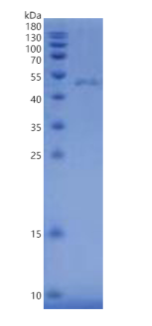
Analytical Data
-
Gene name
NDUFA10
- Application
-
Alternative Names
NDUFA10; NADH dehydrogenase [ubiquinone] 1 alpha subcomplex subunit 10; mitochondrial; Complex I-42kD; CI-42kD; NADH-ubiquinone oxidoreductase 42 kDa subunit
-
Species
Human
-
Source
E. coli
-
Tag
His tag N-Terminus
-
Purity
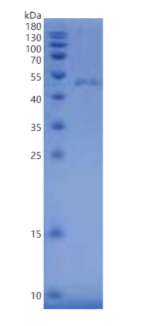
Greater than 90% as determined by SDS-PAGE.
-
Uniprot
O95299
-
Expression Region
1-355 aa
-
AA Sequence
MALRLLKLAATSASARVVAAGAQRVRGIHSSVQCKLRYGMWHFLLGDKASKRLT ERSRVITVDGNICTGKGKLAKEIAEKLGFKHFPEAGIHYPDSTTGDGKPLATDY NGNCSLEKFYDDPRSNDGNSYRLQSWLYSSRLLQYSDALEHLLTTGQGVVLERS IFSDFVFLEAMYNQGFIRKQCVDHYNEVKSVTICDYLPPHLVIYIDVPVPEVQR RIQKKGDPHEMKITSAYLQDIENAYKKTFLPEMSEKCEVLQYSAREAQDSKKVV EDIEYLKFDKGPWLKQDNRTLYHLRLLVQDKFEVLNYTSIPIFLPEVTIGAHQT DRVLHQFRELPGRKYSPGYNTEVGDKWIWLK
-
Molecular Weight
44.1kDa
-
Endotoxin
< 1.0 EU per μg protein as determined by the LAL method.
-
Form
Freeze-dried powder
-
Buffer formulation
PBS, pH7.4, containing 0.01% SKL, 1mM DTT, 5% Trehalose and Proclin300.
-
Reconstitution
Reconstitute in ddH2O to a concentration of 0.1-0.5 mg/mL. Do not vortex.
- Customization
-
Stability Test
The thermal stability is described by the loss rate. The loss rate was determined by accelerated thermal degradation test, that is, incubate the protein at 37℃ for 48h, and no obvious degradation and precipitation were observed. The loss rate isless than 8% within the expiration date under appropriate storage condition.
-
Storage & Shelf Life
Samples are stable for up to twelve months from date of receipt at -20℃ to -80℃. Store it under sterile conditions at -20℃ to -80℃. It is recommended that the protein be aliquoted for optimal storage. Avoid repeated freeze-thaw cycles.
-
Shipping
In general, recombinant proteins are supplied as lyophilized powder and shipped at ambient temperature. For bulk packages, the proteins are provided as frozen liquid and shipped with blue ice, unless otherwise requested by the customer.
Quality inspection process

Related Products
Identification
Protein Description
NDUFA10, a crucial component of the mitochondrial respiratory chain, plays a significant role in cellular energy production through oxidative phosphorylation. It is part of the NADH:ubiquinone oxidoreductase complex (Complex I), which is essential for ATP synthesis and maintaining mitochondrial function. Dysregulation or mutations in NDUFA10 can lead to various mitochondrial disorders, characterized by energy deficiency and an array of pathological features affecting multiple organ systems. Given the increasing prevalence of mitochondrial diseases and their complex genetic underpinnings, studying NDUFA10 and its recombinant protein has gained prominence. Researchers aim to understand the precise functions and mechanisms of NDUFA10 in both normal physiology and disease states. By developing and characterizing NDUFA10 recombinant proteins, scientists can explore therapeutic avenues, such as gene therapy or small molecule approaches to enhance mitochondrial function. Furthermore, studying the structural and functional aspects of the recombinant protein can provide insights into the design of drugs that target Complex I deficiencies. Overall, research on NDUFA10 recombinant protein not only contributes to a deeper understanding of mitochondrial biology but also holds potential for developing innovative strategies to address mitochondrial-related diseases.







