

Analytical Data
-
Gene name
DDT
- Application
-
Alternative Names
DDT;REDD2;RTP801L;DNA damage-inducible transcript 4-like Protein
-
Species
Human
-
Source
E. coli
-
Tag
His tag N-Terminus
-
Purity
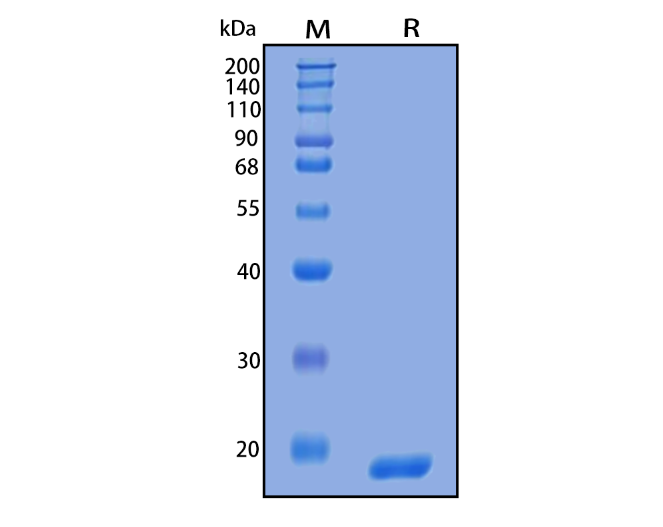
Greater than 90% as determined by SDS-PAGE.
-
Uniprot
P30046
-
Expression Region
1-118aa
-
AA Sequence
MGSSHHHHHHSSGLVPRGSHMPFLELDTNLPANRVPAGLEKRLCAAAASI LGKPADRVNVTVRPGLAMALSGSTEPCAQLSISSIGVVGTAEDNRSHSAH FFEFLTKELALGQDRILIRFFPLESWQIGKIGTVMTFL
-
Molecular Weight
15 kDa
-
Endotoxin
< 1.0 EU per μg protein as determined by the LAL method.
-
Form
Freeze-dried powder
-
Buffer formulation
PBS, pH7.4, containing 0.01% SKL, 1mM DTT, 5% Trehalose and Proclin300.
-
Reconstitution
Reconstitute in ddH2O to a concentration of 0.1-0.5 mg/mL. Do not vortex.
- Customization
-
Stability Test
The thermal stability is described by the loss rate. The loss rate was determined by accelerated thermal degradation test, that is, incubate the protein at 37℃ for 48h, and no obvious degradation and precipitation were observed. The loss rate isless than 8% within the expiration date under appropriate storage condition.
-
Storage & Shelf Life
Samples are stable for up to twelve months from date of receipt at -20℃ to -80℃. Store it under sterile conditions at -20℃ to -80℃. It is recommended that the protein be aliquoted for optimal storage. Avoid repeated freeze-thaw cycles.
-
Shipping
In general, recombinant proteins are supplied as lyophilized powder and shipped at ambient temperature. For bulk packages, the proteins are provided as frozen liquid and shipped with blue ice, unless otherwise requested by the customer.
Quality inspection process

Related Products
Protein Description
DDT, or Diphtheria Toxin Domain, is a significant focus in the study of recombinant proteins due to its potential applications in immunotherapy and targeted drug delivery. Originally derived from the diphtheria bacterium, this protein exhibits potent cytotoxicity, making it a valuable tool in cancer treatment. Researchers have been exploring the possibilities of modifying DDT to enhance its specificity and reduce side effects while maintaining its therapeutic efficacy. The ability to engineer DDT into a recombinant form allows for the development of fusion proteins that can selectively target and kill malignant cells, offering a promising alternative to conventional therapies. Additionally, DDT’s role in vaccine development is being investigated, aiming to use its immunogenic properties to create vaccines that elicit strong immune responses against various diseases. This research is driven by the need for more effective and safer treatment options in oncology and infectious diseases, as current therapies often come with substantial side effects and limitations. Advances in genetic engineering techniques have further propelled the study of DDT, allowing for the design of tailored therapies that can potentially improve patient outcomes. Overall, the exploration of DDT as a recombinant protein represents a cutting-edge intersection of microbiology, biotechnology, and medicine, holding significant promise for the future of disease treatment and prevention.







