

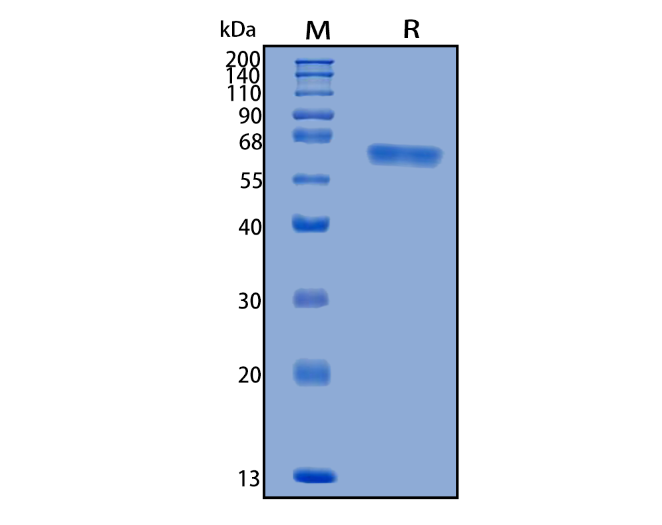
Analytical Data
-
Gene name
CIP2A
- Application
-
Alternative Names
CIP2A;KIAA1524;Protein CIP2A
-
Species
Human
-
Source
E. coli
-
Tag
N-terminal His Tag
-
Purity
Greater than 90% as determined by SDS-PAGE.
-
Uniprot
Q8TCG1
-
Expression Region
1-560aa
-
AA Sequence
MDSTACLKSLLLTVSQYKAVKSEANATQLLRHLEVISGQKLTRLFTSNQILTSE CLSCLVELLEDPNISASLILSIIGLLSQLAVDIETRDCLQNTYNLNSVLAGVVC RSSHTDSVFLQCIQLLQKLTYNVKIFYSGANIDELITFLIDHIQSSEDELKMPC LGLLANLCRHNLSVQTHIKTLSNVKSFYRTLITLLAHSSLTVVVFALSILSSLT LNEEVGEKLFHARNIHQTFQLIFNILINGDGTLTRKYSVDLLMDLLKNPKIADY LTRYEHFSSCLHQVLGLLNGKDPDSSSKVLELLLAFCSVTQLRHMLTQMMFEQS PPGSATLGSHTKCLEPTVALLRWLSQPLDGSENCSVLALELFKEIFEDVIDAAN CSSADRFVTLLLPTILDQLQFTEQNLDEALTRKKCERIAKAIEVLLTLCGDDTL KMHIAKILTTVKCTTLIEQQFTYGKIDLGFGTKVADSELCKLAADVILKTLDLI NKLKPLVPGMEVSFYKILQDPRLITPLAFALTSDNREQVQSGLRILLEAAPLPD FPALVLGESIAANNAYRQQE
-
Molecular Weight
65.6kDa
-
Endotoxin
< 1.0 EU per μg protein as determined by the LAL method.
-
Form
Freeze-dried powder
-
Buffer formulation
PBS, pH7.4, containing 0.01% SKL, 1mM DTT, 5% Trehalose and Proclin300.
-
Reconstitution
Reconstitute in ddH2O to a concentration of 0.1-0.5 mg/mL. Do not vortex.
- Customization
-
Stability Test
The thermal stability is described by the loss rate. The loss rate was determined by accelerated thermal degradation test, that is, incubate the protein at 37℃ for 48h, and no obvious degradation and precipitation were observed. The loss rate isless than 8% within the expiration date under appropriate storage condition.
-
Storage & Shelf Life
Samples are stable for up to twelve months from date of receipt at -20℃ to -80℃. Store it under sterile conditions at -20℃ to -80℃. It is recommended that the protein be aliquoted for optimal storage. Avoid repeated freeze-thaw cycles.
-
Shipping
In general, recombinant proteins are supplied as lyophilized powder and shipped at ambient temperature. For bulk packages, the proteins are provided as frozen liquid and shipped with blue ice, unless otherwise requested by the customer.
Quality inspection process

Related Products
Identification
Protein Description
CIP2A (Cancerous Inhibitor of Protein Phosphatase 2A) is a critical oncoprotein that has garnered significant attention in cancer research due to its role in tumorigenesis and cancer progression. Overexpression of CIP2A has been linked to various malignancies, including breast, ovarian, and gastric cancers, where it acts by inhibiting Protein Phosphatase 2A (PP2A), a pivotal tumor suppressor. This interaction disrupts PP2A's function, leading to the activation of pro-oncogenic signaling pathways, such as the AKT and MYC pathways, which contribute to cellular proliferation and survival. Consequently, CIP2A has emerged as a promising therapeutic target, with studies exploring the potential of targeting its expression or function to restore PP2A activity in cancer cells. Furthermore, CIP2A's involvement in facilitating cancer stem cell properties and drug resistance highlights its importance in the context of personalized medicine, as targeting CIP2A could improve treatment outcomes for patients. Investigating the molecular mechanisms underlying CIP2A's function and its interactions with key regulatory proteins is pivotal for developing novel cancer therapies aimed at inhibiting tumor growth and overcoming resistance to existing treatments. The generation and characterization of recombinant CIP2A protein serve as crucial steps in elucidating its biochemical properties and functional roles, providing opportunities for high-throughput screening of small molecules that can modulate its activity, ultimately contributing to innovative therapeutic strategies in oncology.







