

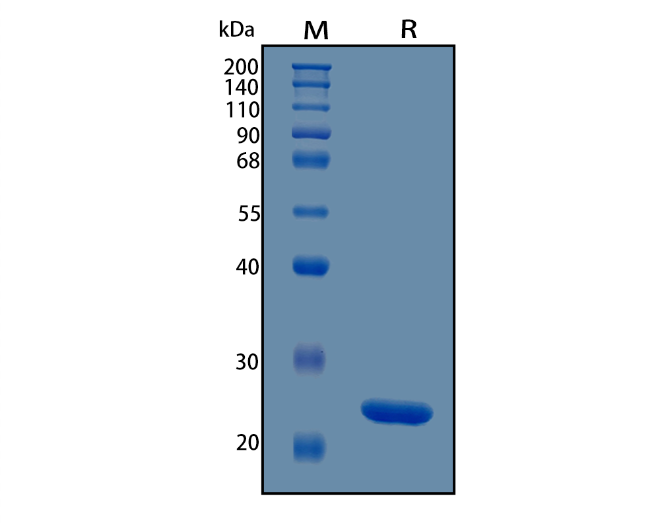
Analytical Data
-
Gene name
ALT2
- Application
-
Alternative Names
ALT2;AAT2;ALT2;Alanine aminotransferase 2
-
Species
Human
-
Source
E. coli
-
Tag
His tag N-Terminus
-
Purity
Greater than 90% as determined by SDS-PAGE.
-
Uniprot
Q8TD30
-
Expression Region
1-523aa
-
AA Sequence
MGSSHHHHHH SSGLVPRGSH MGSMQRAAAL VRRGCGPRTP SSWGRSQSSA AAEASAVLKV RPERSRRERI LTLESMNPQV KAVEYAVRGP IVLKAGEIEL ELQRGIKKPF TEVIRANIGD AQAMGQQPIT FLRQVMALCT YPNLLDSPSF PEDAKKRARR ILQACGGNSL GSYSASQGVN CIREDVAAYI TRRDGGVPAD PDNIYLTTGA SDGISTILKI LVSGGGKSRT GVMIPIPQYP LYSAVISELD AIQVNYYLDE ENCWALNVNE LRRAVQEAKD HCDPKVLCII NPGNPTGQVQ SRKCIEDVIH FAWEEKLFLL ADEVYQDNVY SPDCRFHSFK KVLYEMGPEY SSNVELASFH STSKGYMGEC GYRGGYMEVI NLHPEIKGQL VKLLSVRLCP PVSGQAAMDI VVNPPVAGEE SFEQFSREKE SVLGNLAKKA KLTEDLFNQV PGIHCNPLQG AMYAFPRIFI PAKAVEAAQA HQMAPDMFYC MKLLEETGIC VVPGSGFGQR EGTYHFRMTI LPPVEKLKTV LQKVKDFHIN FLEKYA
-
Molecular Weight
60 kDa
-
Endotoxin
< 1.0 EU per μg protein as determined by the LAL method.
-
Form
Freeze-dried powder
-
Buffer formulation
PBS, pH7.4, containing 0.01% SKL, 1mM DTT, 5% Trehalose and Proclin300.
-
Reconstitution
Reconstitute in ddH2O to a concentration of 0.1-0.5 mg/mL. Do not vortex.
- Customization
-
Stability Test
The thermal stability is described by the loss rate. The loss rate was determined by accelerated thermal degradation test, that is, incubate the protein at 37℃ for 48h, and no obvious degradation and precipitation were observed. The loss rate isless than 8% within the expiration date under appropriate storage condition.
-
Storage & Shelf Life
Samples are stable for up to twelve months from date of receipt at -20℃ to -80℃. Store it under sterile conditions at -20℃ to -80℃. It is recommended that the protein be aliquoted for optimal storage. Avoid repeated freeze-thaw cycles.
-
Shipping
In general, recombinant proteins are supplied as lyophilized powder and shipped at ambient temperature. For bulk packages, the proteins are provided as frozen liquid and shipped with blue ice, unless otherwise requested by the customer.
Quality inspection process

Related Products
Protein Description
The ALT2 protein is a member of the ALT (Alternative Lengthening of Telomeres) pathway, which is a crucial mechanism for telomere maintenance in certain types of cancer cells, particularly those that are not reliant on the telomerase enzyme. Research into ALT mechanisms has gained significant attention due to their implications in tumor biology and potential therapeutic targets, as these pathways allow cancer cells to proliferate indefinitely despite the cytotoxic effects of telomere shortening. The ALT2 variant, in particular, has been less studied compared to other ALT-related proteins; however, preliminary investigations suggest it might play a pivotal role in telomere dynamics and stability in ALT-positive tumors. Understanding the structure and function of ALT2 proteins could shed light on the molecular underpinnings of telomere maintenance strategies utilized by cancer cells. Furthermore, the study of ALT2 may provide insights into novel biomarkers for cancer prognosis or progression, as well as potential targets for developing therapies that specifically disrupt these ALT pathways, ultimately enhancing the effectiveness of cancer treatments. The research surrounding ALT2 recombinant proteins is thus a rapidly expanding field that holds promise for contributing to our understanding of cancer biology and improving treatment strategies for malignancies that utilize telomere maintenance through the ALT mechanism.







