

Analytical Data
-
Gene name
TUBA8
- Application
-
Alternative Names
Alpha tubulin 8; Alpha-tubulin 8; TBA8_HUMAN; Tuba8; TUBAL2; Tubulin alpha 8 chain; Tubulin alpha chain like 2; Tubulin alpha chain-like 2; Tubulin alpha-8 chain
-
Species
Human
-
Source
E. coli
-
Tag
His tag N-Terminus
-
Purity
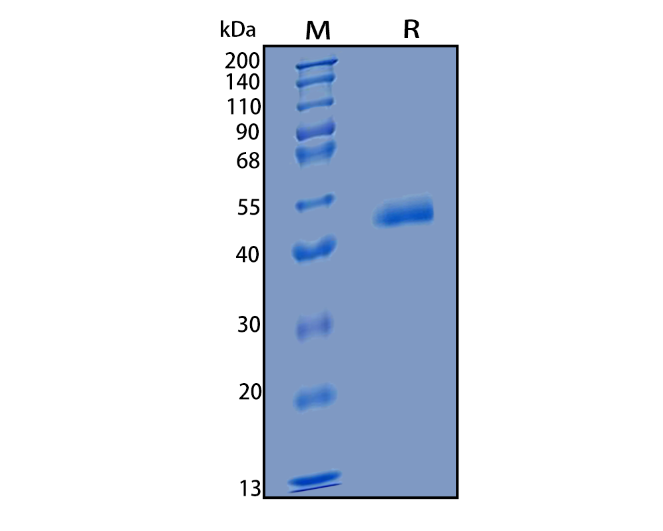
Greater than 90% as determined by SDS-PAGE.
-
Uniprot
Q9NY65
-
Expression Region
1-449 aa
-
AA Sequence
MRECISVHVG QAGVQIGNAC WELFCLEHGI QADGTFDAQA SKINDDDSFT TFFSETGNGK HVPRAVMIDL EPTVVDEVRA GTYRQLFHPE QLITGKEDAA NNYARGHYTV GKESIDLVLD RIRKLTDACS GLQGFLIFHS FGGGTGSGFT SLLMERLSLD YGKKSKLEFA IYPAPQVSTA VVEPYNSILT THTTLEHSDC AFMVDNEAIY DICRRNLDIE RPTYTNLNRL ISQIVSSITA SLRFDGALNV DLTEFQTNLV PYPRIHFPLV TYAPIISAEK AYHEQLSVAE ITSSCFEPNS QMVKCDPRHG KYMACCMLYR GDVVPKDVNV AIAAIKTKRT IQFVDWCPTG FKVGINYQPP TVVPGGDLAK VQRAVCMLSN TTAIAEAWAR LDHKFDLMYA KRAFVHWYVG EGMEEGEFSE AREDLAALEK DYEEVGTDSF EEENEGEEF
-
Molecular Weight
50.0 kDa
-
Endotoxin
< 1.0 EU per μg protein as determined by the LAL method.
-
Form
Freeze-dried powder
-
Buffer formulation
PBS, pH7.4, containing 0.01% SKL, 1mM DTT, 5% Trehalose and Proclin300.
-
Reconstitution
Reconstitute in ddH2O to a concentration of 0.1-0.5 mg/mL. Do not vortex.
- Customization
-
Stability Test
The thermal stability is described by the loss rate. The loss rate was determined by accelerated thermal degradation test, that is, incubate the protein at 37℃ for 48h, and no obvious degradation and precipitation were observed. The loss rate isless than 8% within the expiration date under appropriate storage condition.
-
Storage & Shelf Life
Samples are stable for up to twelve months from date of receipt at -20℃ to -80℃. Store it under sterile conditions at -20℃ to -80℃. It is recommended that the protein be aliquoted for optimal storage. Avoid repeated freeze-thaw cycles.
-
Shipping
In general, recombinant proteins are supplied as lyophilized powder and shipped at ambient temperature. For bulk packages, the proteins are provided as frozen liquid and shipped with blue ice, unless otherwise requested by the customer.
Quality inspection process

Related Products
Protein Description
TUBA8, a member of the tubulin protein family, plays a pivotal role in microtubule dynamics, which are essential for various cellular processes including mitosis, intracellular transport, and maintenance of cell shape. Research into TUBA8 has gained momentum due to its potential implications in cell biology and disease mechanisms, particularly in cancer and neurodegenerative disorders. Its unique structure and function suggest that TUBA8 may interact with specific binding partners, influencing microtubule stability and organization. Understanding the biochemical properties and functional roles of TUBA8 can provide insights into the regulatory mechanisms of the cytoskeleton and could unveil novel therapeutic targets. Recent studies employing recombinant TUBA8 have been aimed at elucidating its interactions and assembly dynamics in vitro, presenting opportunities to explore its contributions to cellular morphology and motility. With advances in techniques such as cryo-electron microscopy and molecular dynamics simulations, researchers are better equipped to investigate the conformational flexibility and binding affinities of TUBA8. As the field progresses, the characterization of TUBA8 through interdisciplinary approaches is expected to shed light on its significance in health and disease, ultimately contributing to the development of innovative strategies for intervention and treatment in relevant pathologies.







