

Analytical Data
-
Gene name
SMA4
- Application
-
Alternative Names
BCD541; Component of gems 1; Gemin 1; Gemin-1; OTTHUMP00000125198; OTTHUMP00000223567; OTTHUMP00000223568; OTTHUMP00000224066; OTTHUMP00000226924; SMA 1; SMA 2; SMA 3; SMA 4; SMA; SMA@; SMA1; SMA2; SMA3; SMA4; SMN; SMN_HUMAN; SMN1; SMN2; SMNT; Survival motor neuron protein; Survival of motor neuron 1. telomeric; T-BCD541
-
Species
Human
-
Source
E. coli
-
Tag
His tag N-Terminus
-
Purity
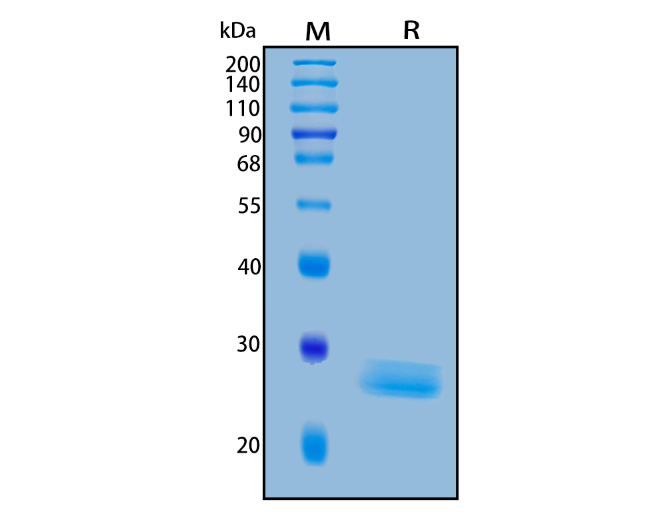
Greater than 90% as determined by SDS-PAGE.
-
Uniprot
Q16637
-
Expression Region
2-294 aa
-
AA Sequence
AMSSGGSGG GVPEQEDSVL FRRGTGQSDD SDIWDDTALI KAYDKAVASF KHALKNGDIC ETSGKPKTTP KRKPAKKNKS QKKNTSLQ QWKVGDKCSA IWSEDGCIYP ATIASIDFKR ETCVVVYTGY GNREEQNLSD LLSPICEVAN NIEQNAQENE NESQVSTDES ENSRSPGNKS DNIKPKSAPW NSFLPPPPPM PGPRLGPGKP GLKFNGPPPP PPPPPPHLLS CWLPPFPSGP PIIPPPPPIC PDSLDDADAL GSMLISWYMS GYHTGYYMGF RQNQKEGRCS HSLN
-
Molecular Weight
31.8 kDa
-
Endotoxin
< 1.0 EU per μg protein as determined by the LAL method.
-
Form
Freeze-dried powder
-
Buffer formulation
PBS, pH7.4, containing 0.01% SKL, 1mM DTT, 5% Trehalose and Proclin300.
-
Reconstitution
Reconstitute in ddH2O to a concentration of 0.1-0.5 mg/mL. Do not vortex.
- Customization
-
Stability Test
The thermal stability is described by the loss rate. The loss rate was determined by accelerated thermal degradation test, that is, incubate the protein at 37℃ for 48h, and no obvious degradation and precipitation were observed. The loss rate isless than 8% within the expiration date under appropriate storage condition.
-
Storage & Shelf Life
Samples are stable for up to twelve months from date of receipt at -20℃ to -80℃. Store it under sterile conditions at -20℃ to -80℃. It is recommended that the protein be aliquoted for optimal storage. Avoid repeated freeze-thaw cycles.
-
Shipping
In general, recombinant proteins are supplied as lyophilized powder and shipped at ambient temperature. For bulk packages, the proteins are provided as frozen liquid and shipped with blue ice, unless otherwise requested by the customer.
Quality inspection process

Related Products
Protein Description
The research on SMA4 recombinant protein is rooted in the study of spinal muscular atrophy (SMA), a genetic disorder characterized by the loss of motor neurons in the spinal cord, leading to progressive muscle weakness and atrophy. Caused primarily by mutations in the survival motor neuron 1 (SMN1) gene, SMA affects infants and children, resulting in severe physical disabilities and significantly impacting their quality of life. Despite the identification of SMN2, a closely related gene that can partially compensate for SMN1 deficiency, the therapeutic strategies to enhance SMN protein production have been limited. The development of SMA4 recombinant protein represents a potential breakthrough in SMA treatment by harnessing advanced biotechnological methods to produce a modified version of the SMN protein that could improve stability, functionality, and overall therapeutic effectiveness. This research aims to understand the biological mechanisms and potential applications of SMA4 in restoring motor neuron function, thereby offering hope for affected individuals. By elucidating the structural and functional characteristics of the SMA4 protein, researchers hope to pave the way for novel therapies that can mitigate the impact of SMA, address the needs for effective treatment, and ultimately improve patient outcomes.







