

Analytical Data
-
Gene name
GAB3
- Application
-
Alternative Names
GAB3;GRB2-associated-binding Protein 3
-
Species
Human
-
Source
E. coli
-
Tag
His tag N-Terminus
-
Purity
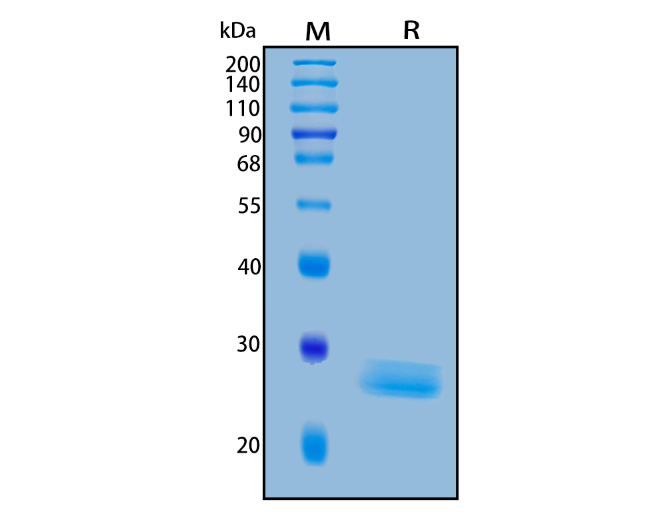
Greater than 90% as determined by SDS-PAGE.
-
Uniprot
Q8WWW8
-
Expression Region
1-586aa
-
AA Sequence
MSAGDAVCTG WLVKSPPERK LQRYAWRKRW FVLRRGRMSG NPDVLEYYRN KHSSKPIRVI DLSECAVWKH VGPSFVRKEF QNNFVFIVKT TSRTFYLVAK TEQEMQVWVH SISQVCNLGH LEDGADSMES LSYTPSSLQP SSASSLLTAH AASSSLPRDD PNTNAVATEE TRSESELLFL PDYLVLSNCE TGRLHHTSLP TRCDSWSNSD RSLEQASFDD VFVDCLQPLP SSHLVHPSCH GSGAQEVPSS RPQAALIWSR EINGPPRDHL SSSPLLESSL SSTIQVDKNQ GSLPCGAKEL DIMSNTPPPR PPKPSHLSER RQEEWSTHSG SKKPECTLVP RRISLSGLDN MRTWKADVEG QSLRHRDKRL SLNLPCRFSP MYPTASASIE DSYVPMSPQA GASGLGPHCS PDDYIPMNSG SISSPLPELP ANLEPPPVNR DLKPQRKSRP PPLDLRNLSI IREHASLTRT RTVPCSRTSF LSPERNGINS ARFFANPVSR EDEESYIEME EHRTASSLSS GALTWTKKFS LDYLALDFNS ASPAPMQQKL LLSEEQRVDY VQVDEQKTQA LQSTKQEWTD ERQSKV
-
Endotoxin
< 1.0 EU per μg protein as determined by the LAL method.
-
Form
Freeze-dried powder
-
Buffer formulation
PBS, pH7.4, containing 0.01% SKL, 1mM DTT, 5% Trehalose and Proclin300.
-
Reconstitution
Reconstitute in ddH2O to a concentration of 0.1-0.5 mg/mL. Do not vortex.
- Customization
-
Stability Test
The thermal stability is described by the loss rate. The loss rate was determined by accelerated thermal degradation test, that is, incubate the protein at 37℃ for 48h, and no obvious degradation and precipitation were observed. The loss rate isless than 8% within the expiration date under appropriate storage condition.
-
Storage & Shelf Life
Samples are stable for up to twelve months from date of receipt at -20℃ to -80℃. Store it under sterile conditions at -20℃ to -80℃. It is recommended that the protein be aliquoted for optimal storage. Avoid repeated freeze-thaw cycles.
-
Shipping
In general, recombinant proteins are supplied as lyophilized powder and shipped at ambient temperature. For bulk packages, the proteins are provided as frozen liquid and shipped with blue ice, unless otherwise requested by the customer.
Quality inspection process

Related Products
Protein Description
GAB3 (GRB2-associated binding protein 3) is a member of the Gab family of adaptor proteins, which play a crucial role in various cellular signaling pathways that regulate growth, differentiation, and survival. The study of GAB3 has gained significance due to its involvement in signaling cascades mediated by receptor tyrosine kinases, such as the insulin receptor and various growth factor receptors. Aberrant GAB3 expression or function has been implicated in several pathological conditions, including cancer, where it may contribute to tumorigenesis and metastasis by promoting cell proliferation and survival through the activation of downstream signaling pathways. Recombinant GAB3 protein production is instrumental for elucidating its molecular mechanisms and interactions with other signaling molecules. Researchers utilize recombinant GAB3 for structural studies, functional assays, and to investigate its role in cellular contexts. Understanding GAB3's structure and function can provide insights into its therapeutic potential, particularly in targeting specific signaling pathways in cancer and other diseases. The development of GAB3 recombinant proteins facilitates the exploration of novel strategies for intervention in related pathologies, underscoring the relevance of this protein in biomedical research.







