

Analytical Data
-
Gene name
FCN1
- Application
-
Alternative Names
FCN1;FCNM;Ficolin-1
-
Species
Human
-
Source
E. coli
-
Tag
His tag N-Terminus
-
Purity
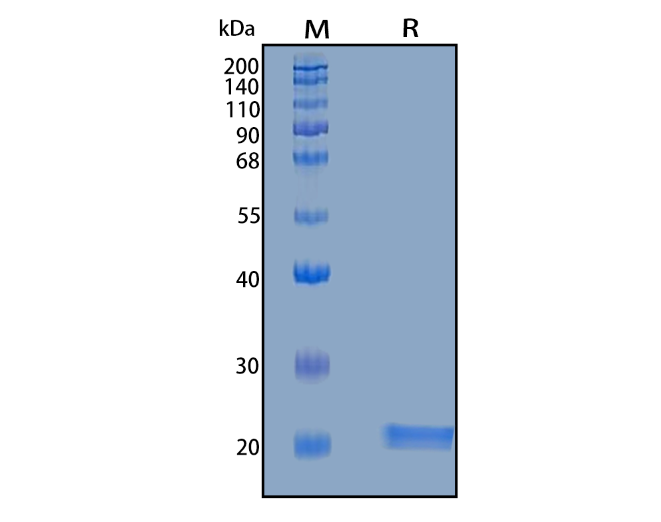
Greater than 90% as determined by SDS-PAGE.
-
Uniprot
O00602
-
Expression Region
1-326aa
-
AA Sequence
MELSGATMAR GLAVLLVLFL HIKNLPAQAA DTCPEVKVVG LEGSDKLTIL RGCPGLPGAP GPKGEAGVIG ERGERGLPGA PGKAGPVGPK GDRGEKGMRG EKGDAGQSQS CATGPRNCKD LLDRGYFLSG WHTIYLPDCR PLTVLCDMDT DGGGWTVFQR RMDGSVDFYR DWAAYKQGFG SQLGEFWLGN DNIHALTAQG SSELRVDLVD FEGNHQFAKY KSFKVADEAE KYKLVLGAFV GGSAGNSLTG HNNNFFSTKD QDNDVSSSNC AEKFQGAWWY ADCHASNLNG LYLMGPHESY ANGINWSAAK GYKYSYKVSE MKVRPA
-
Molecular Weight
34 kDa
-
Endotoxin
< 1.0 EU per μg protein as determined by the LAL method.
-
Form
Freeze-dried powder
-
Buffer formulation
PBS, pH7.4, containing 0.01% SKL, 1mM DTT, 5% Trehalose and Proclin300.
-
Reconstitution
Reconstitute in ddH2O to a concentration of 0.1-0.5 mg/mL. Do not vortex.
- Customization
-
Stability Test
The thermal stability is described by the loss rate. The loss rate was determined by accelerated thermal degradation test, that is, incubate the protein at 37℃ for 48h, and no obvious degradation and precipitation were observed. The loss rate isless than 8% within the expiration date under appropriate storage condition.
-
Storage & Shelf Life
Samples are stable for up to twelve months from date of receipt at -20℃ to -80℃. Store it under sterile conditions at -20℃ to -80℃. It is recommended that the protein be aliquoted for optimal storage. Avoid repeated freeze-thaw cycles.
-
Shipping
In general, recombinant proteins are supplied as lyophilized powder and shipped at ambient temperature. For bulk packages, the proteins are provided as frozen liquid and shipped with blue ice, unless otherwise requested by the customer.
Quality inspection process

Related Products
Protein Description
FCN1, or Ficolin-1, is a pattern recognition receptor that plays a crucial role in the innate immune system. It is primarily produced in the liver and is secreted in the serum, where it binds to carbohydrate patterns on pathogens, thereby facilitating their recognition and clearance. The study of FCN1 recombinant protein has gained significant interest due to its potential implications in understanding immune responses and developing therapeutic approaches for various diseases. Research has shown that FCN1 can activate the lectin complement pathway, contributing to opsonization and enhanced phagocytosis of pathogens, as well as modulating inflammation. Moreover, variations in FCN1 expression and function have been associated with susceptibility to infections, autoimmune disorders, and other inflammatory conditions. With advancements in recombinant DNA technology, producing FCN1 as a recombinant protein allows researchers to investigate its properties, interactions, and potential applications in biochemical assays and therapeutic interventions. This research not only provides insights into FCN1's role in the immune system but also opens avenues for innovative strategies to modulate immune responses in clinical settings.







