

Analytical Data
-
Gene name
ESRRA
- Application
-
Alternative Names
ESRRA;ERR1;ESRL1;NR3B1;Steroid hormone receptor ERR1
-
Species
Human
-
Source
E. coli
-
Tag
His tag N-Terminus
-
Purity
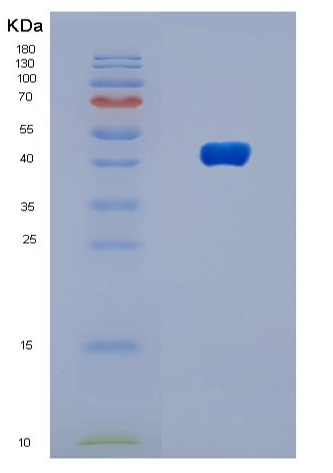
Greater than 90% as determined by SDS-PAGE.
-
Uniprot
P11474
-
Expression Region
1-423aa
-
AA Sequence
MSSQVVGIEPLYIKAEPASPDSPKGSSETETEPPVALAPGPAPTRCLPGHKEEEDGEGAGPGEQGGGKLVLSSLPKRLCLVCGDVASGYHYGVASCEACKAFFKRTIQGSIEYSCPASNECEITKRRRKACQACRFTKCLRVGMLKEGVRLDRVRGGRQKYKRRPEVDPLPFPGPFPAGPLAVAGGPRKTAAPVNALVSHLLVVEPEKLYAMPDPAGPDGHLPAVATLCDLFDREIVVTISWAKSIPGFSSLSLSDQMSVLQSVWMEVLVLGVAQRSLPLQDELAFAEDLVLDEEGARAAGLGELGAALLQLVRRLQALRLEREEYVLLKALALANSDSVHIEDAEAVEQLREALHEALLEYEAGRAGPGGGAERRRAGRLLLTLPLLRQTAGKVLAHFYGVKLEGKVPMHKLFLEMLEAMMD
-
Molecular Weight
48.9kDa
-
Endotoxin
< 1.0 EU per μg protein as determined by the LAL method.
-
Form
Freeze-dried powder
-
Buffer formulation
PBS, pH7.4, containing 0.01% SKL, 1mM DTT, 5% Trehalose and Proclin300.
-
Reconstitution
Reconstitute in ddH2O to a concentration of 0.1-0.5 mg/mL. Do not vortex.
- Customization
-
Stability Test
The thermal stability is described by the loss rate. The loss rate was determined by accelerated thermal degradation test, that is, incubate the protein at 37℃ for 48h, and no obvious degradation and precipitation were observed. The loss rate isless than 8% within the expiration date under appropriate storage condition.
-
Storage & Shelf Life
Samples are stable for up to twelve months from date of receipt at -20℃ to -80℃. Store it under sterile conditions at -20℃ to -80℃. It is recommended that the protein be aliquoted for optimal storage. Avoid repeated freeze-thaw cycles.
-
Shipping
In general, recombinant proteins are supplied as lyophilized powder and shipped at ambient temperature. For bulk packages, the proteins are provided as frozen liquid and shipped with blue ice, unless otherwise requested by the customer.
Quality inspection process

Related Products
Identification
Protein Description
ESRRA (Estrogen Related Receptor Alpha) is a member of the nuclear receptor superfamily that plays a crucial role in various physiological processes, including metabolism, cell differentiation, and tissue homeostasis. Its involvement in the regulation of gene expression makes it a potential target for therapeutic interventions in diverse conditions such as obesity, diabetes, and cancer. Research over the past few decades has indicated that ESRRA is not only implicated in metabolic pathways but also plays a pivotal role in the body's response to estrogen, linking it to reproductive health and certain hormone-dependent cancers. The functional characteristics of ESRRA are influenced by its ability to form heterodimers with other nuclear receptors and interact with cofactors, which modulates its transcriptional activity. The recombinant expression of ESRRA protein allows for in-depth studies of its structure and function, enabling researchers to investigate the molecular mechanisms underlying its regulatory actions. Additionally, understanding ESRRA's role in various signaling pathways may provide insights into its potential as a biomarker for disease prognosis and treatment strategies. The stringent regulation of ESRRA activity highlights its importance in maintaining cellular homeostasis, making it a focal point for ongoing research in molecular biology and pharmacology. By harnessing recombinant technology to produce ESRRA, scientists aim to elucidate its functional properties, paving the way for future therapeutic developments that target this nuclear receptor and its related pathways.







