

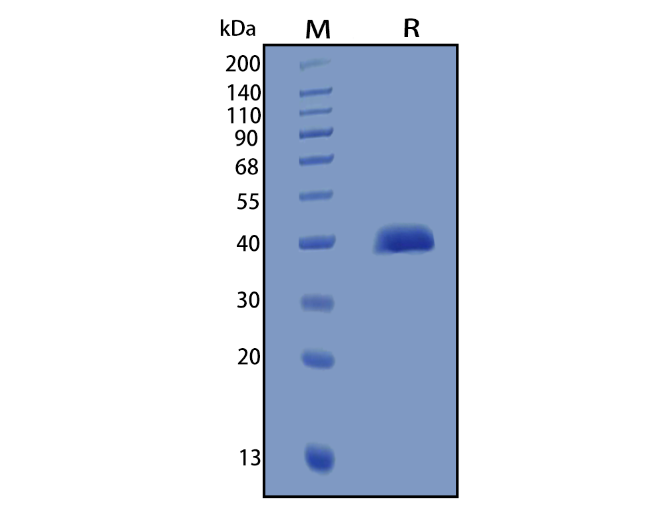
Analytical Data
-
Gene name
ERK2
- Application
-
Alternative Names
ERK2;ERK2;PRKM1;PRKM2;Mitogen-activated Protein kinase 1
-
Species
Human
-
Source
E. coli
-
Tag
N-6His
-
Purity
Greater than 90% as determined by SDS-PAGE.
-
Uniprot
P28482
-
Expression Region
1-360aa
-
AA Sequence
AAAAAAGAG PEMVRGQVFD VGPRYTNLSY IGEGAYGMVC SAYDNVNKVR VAIKKISPFE HQTYCQRTLR EIKILLRFRH ENIIGINDII RAPTIEQMKD VYIVQDLMET DLYKLLKTQH LSNDHICYFL YQILRGLKYI HSANVLHRDL KPSNLLLNTT CDLKICDFGL ARVADPDHDH TGFLTEYVAT RWYRAPEIML NSKGYTKSID IWSVGCILAE MLSNRPIFPG KHYLDQLNHI LGILGSPSQE DLNCIINLKA RNYLLSLPHK NKVPWNRLFP NADSKALDLL DKMLTFNPHK RIEVEQALAH PYLEQYYDPS DEPIAEAPFK FDMELDDLPK EKLKELIFEE TARFQPGYRS
-
Molecular Weight
43.5 kDa (380aa)
-
Endotoxin
< 1.0 EU per μg protein as determined by the LAL method.
-
Form
Freeze-dried powder
-
Buffer formulation
PBS, pH7.4, containing 0.01% SKL, 1mM DTT, 5% Trehalose and Proclin300.
-
Reconstitution
Reconstitute in ddH2O to a concentration of 0.1-0.5 mg/mL. Do not vortex.
- Customization
-
Stability Test
The thermal stability is described by the loss rate. The loss rate was determined by accelerated thermal degradation test, that is, incubate the protein at 37℃ for 48h, and no obvious degradation and precipitation were observed. The loss rate isless than 8% within the expiration date under appropriate storage condition.
-
Storage & Shelf Life
Samples are stable for up to twelve months from date of receipt at -20℃ to -80℃. Store it under sterile conditions at -20℃ to -80℃. It is recommended that the protein be aliquoted for optimal storage. Avoid repeated freeze-thaw cycles.
-
Shipping
In general, recombinant proteins are supplied as lyophilized powder and shipped at ambient temperature. For bulk packages, the proteins are provided as frozen liquid and shipped with blue ice, unless otherwise requested by the customer.
Quality inspection process

Related Products






Identification
Protein Description
ERK2 (Extracellular signal-regulated kinase 2) is a crucial component of the MAPK (Mitogen-Activated Protein Kinase) signaling pathway, which regulates various cellular processes such as growth, differentiation, and survival. The study of ERK2 has gained significant attention due to its role in various diseases, particularly cancers. Aberrant activation of the ERK pathway has been implicated in tumorigenesis, making ERK2 a potential target for therapeutic intervention. Recombinant expression of ERK2 proteins allows for an in-depth analysis of its biochemical properties, interactions with other cellular proteins, and the mechanisms by which it regulates downstream signaling pathways. By utilizing techniques such as molecular cloning and protein purification, researchers can produce active forms of ERK2 for structural analysis and functional assays. These studies not only advance our understanding of ERK2's role in normal cellular function but also provide insights into how its dysregulation can lead to pathological conditions. Furthermore, the generation of ERK2-targeted inhibitors is of paramount importance in the development of novel cancer therapies. Overall, the research on ERK2 recombinant protein is essential for developing potential diagnostic and therapeutic strategies for diseases associated with its dysregulation.







