

Analytical Data
-
Gene name
CLEC4E
-
简介
CLEC4E Protein is a calcium-dependent lectin displaying mannose-binding specificity, and induces the formation of Birbeck granules (BGs). CLEC4E Protein is a potent regulator of membrane superimposition and zippering, and binds to sulfated as well as mannosylated glycans, keratan sulfate (KS) and beta-glucans. CLEC4E Protein, Rhesus Macaque (HEK293, Fc) is the recombinant Rhesus Macaque-derived CLEC4E protein, expressed by HEK293 , with N-hFc labeled tag.
- Application
-
Biological Activity
Measured by its binding ability in a functional ELISA. Immobilized Trehalose 6, 6'-Dimycolate at 1 μg/mL(100 μL/well) can bind Rhesus Macaque CLEC4E. The ED50 for this effect is 0.2905 μg/mL. Measured by its binding ability in a functional ELISA. Immobilized Trehalose 6, 6'-Dimycolate at 1 μg/mL(100 μL/well) can bind Rhesus Macaque CLEC4E. The ED50 for this effect is 0.2905 μg/mL.
-
Alternative Names
C-Type Lectin Domain Family 4 Member E; CLECSF9; MINCLE
-
Species
Rhesus Macaque
-
Source
HEK293
-
Tag
N-hFc
-
Purity
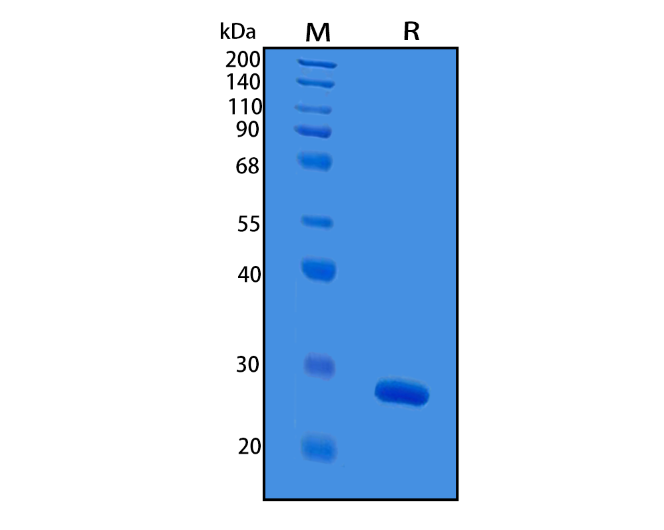
Greater than 90% as determined by SDS-PAGE.
-
Uniprot
XP_001118423.1
-
Expression Region
R41-I219
-
Protein Length
Partial
-
Molecular Weight
49.1 kDa.
-
Endotoxin
< 1.0 EU per μg protein as determined by the LAL method.
-
Form
Freeze-dried powder
-
Buffer formulation
PBS, pH7.4, containing 0.01% SKL, 1mM DTT, 5% Trehalose and Proclin300.
-
Reconstitution
Reconstitute in ddH2O to a concentration of 0.1-0.5 mg/mL. Do not vortex.
- Customization
-
Stability Test
The thermal stability is described by the loss rate. The loss rate was determined by accelerated thermal degradation test, that is, incubate the protein at 37℃ for 48h, and no obvious degradation and precipitation were observed. The loss rate isless than 8% within the expiration date under appropriate storage condition.
-
Storage & Shelf Life
Samples are stable for up to twelve months from date of receipt at -20℃ to -80℃. Store it under sterile conditions at -20℃ to -80℃. It is recommended that the protein be aliquoted for optimal storage. Avoid repeated freeze-thaw cycles.
-
Shipping
In general, recombinant proteins are supplied as lyophilized powder and shipped at ambient temperature. For bulk packages, the proteins are provided as frozen liquid and shipped with blue ice, unless otherwise requested by the customer.
Quality inspection process

Related Products
Protein Description
CLEC4E, also known as DC-SIGNR (Dendritic Cell-Specific Intercellular adhesion molecule-3-Grabbing Non-integrin), is a C-type lectin receptor primarily expressed on dendritic cells and macrophages. Its role in the immune system has garnered significant research interest due to its capacity to recognize and bind to various pathogens, including viruses and bacteria, thereby facilitating their uptake and modulation of immune responses. The structure and function of CLEC4E have been studied extensively to understand its mechanisms in antigen recognition and presentation. Additionally, research has indicated that CLEC4E may play a dual role in promoting immune responses against infections while also being exploited by certain pathogens to evade the immune system. This duality highlights its potential as both a therapeutic target in infectious diseases and a biomarker for immunological studies. Recent investigations have focused on the molecular mechanisms underlying CLEC4E interactions with glycoproteins on pathogen surfaces, aiming to elucidate how these interactions influence the innate immune response. Understanding the structure-function relationship of CLEC4E is vital for developing novel immunotherapeutic strategies and vaccines that harness its innate recognition capabilities for enhanced protection against infectious diseases. With ongoing advancements in structural biology and immunology, research on CLEC4E is expected to yield important insights into its potential applications in clinical immunology and therapeutic interventions.







