

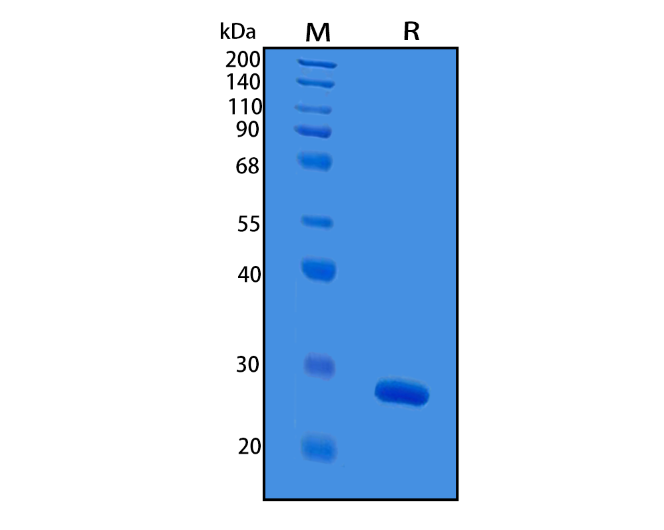
Analytical Data
-
Gene name
DKK-1
-
简介
DKK-1 Protein, with co-receptor and lipoprotein receptor binding activities, crucially regulates ossification and neuron death positively. Primarily located in the extracellular space, DKK-1 is implicated in anodontia, showing biased expression in kidney (RPKM 4.7), brain (RPKM 0.6), and two other tissues. Its role in the WNT signaling pathway and impact on visual epilepsy highlight its significance in developmental and neurological contexts. DKK-1 Protein, Rat (HEK293, C-His) is the recombinant rat-derived DKK-1 protein, expressed by HEK293 , with C-6*His labeled tag.
- Application
-
Biological Activity
Measured by its ability to inhibit Wnt3a-induced alkaline phosphatase production by C3H10T1/2 cells. The ED50 for this effect is approximately 0.1097 μg/ml in the presence of 10 ng/mL of mouse Wnt3a, corresponding to a specific activity is 9115.7703 units/mg. Measured by its ability to inhibit Wnt3a-induced alkaline phosphatase production by C3H10T1/2 cells. The ED50 for this effect is approximately 0.1097 μg/mL in the presence of 10 ng/mL of mouse Wnt3a, corresponding to a specific activity is 9115.7703 units/mg.
-
Alternative Names
dickkopf WNT signaling pathway inhibitor 1; Dickkopf-1; dickkopf-related protein 1; Dkk1; Dkk-1; hDkk-1
-
Species
Rat
-
Source
HEK293
-
Tag
C-6*His
-
Purity
Greater than 95% as determined by SDS-PAGE.
-
Uniprot
A6I0Z0
-
Expression Region
T32-H270
-
AA Sequence
TLNSVLINSNAIKNLPPPLGGAGGQPGSAVSVAPGVLYEGGNKYQTLDNYQPYPCAEDEECGTDEYCSSPSRGAAGVGGVQICLACRKRRKRCMRHAMCCPGNYCKNGICMPSDHSHLPRGEIEEGIIENLGNDHGAGDGYPRRTTLTSKIYHTKGQEGSVCLRSSDCATGLCCARHFWSKICKPVLKEGQVCTKHRRKGSHGLEIFQRCYCGEGLACRIQKDHHQTSNSSRLHTCQRH
-
Protein Length
Full Length of Mature Protein
-
Molecular Weight
38.58 kDa
-
Endotoxin
< 1.0 EU per μg protein as determined by the LAL method.
-
Form
Freeze-dried powder
-
Buffer formulation
PBS, pH7.4, containing 0.01% SKL, 1mM DTT, 5% Trehalose and Proclin300.
-
Reconstitution
Reconstitute in ddH2O to a concentration of 0.1-0.5 mg/mL. Do not vortex.
- Customization
-
Stability Test
The thermal stability is described by the loss rate. The loss rate was determined by accelerated thermal degradation test, that is, incubate the protein at 37℃ for 48h, and no obvious degradation and precipitation were observed. The loss rate isless than 8% within the expiration date under appropriate storage condition.
-
Storage & Shelf Life
Samples are stable for up to twelve months from date of receipt at -20℃ to -80℃. Store it under sterile conditions at -20℃ to -80℃. It is recommended that the protein be aliquoted for optimal storage. Avoid repeated freeze-thaw cycles.
-
Shipping
In general, recombinant proteins are supplied as lyophilized powder and shipped at ambient temperature. For bulk packages, the proteins are provided as frozen liquid and shipped with blue ice, unless otherwise requested by the customer.
Quality inspection process

Related Products
Protein Description
DKK-1 (Dickkopf-related protein 1) is a secreted glycoprotein that plays a crucial role in the regulation of Wnt signaling, a pathway important for various developmental processes and tissue homeostasis. Dysregulation of DKK-1 has been implicated in several pathological conditions, including cancer, osteoporosis, and cardiovascular diseases. In cancer, elevated levels of DKK-1 can promote tumor progression by inhibiting apoptosis in cancer cells and facilitating the creation of a favorable microenvironment for tumor growth. In the context of bone diseases, DKK-1 acts as a negative regulator of osteogenesis, and its overexpression can lead to impaired bone formation, making it a prime target for therapeutic interventions. Researchers are now focusing on developing recombinant DKK-1 proteins to study its biological functions and interactions with other signaling pathways. These studies aim to elucidate the molecular mechanisms underlying DKK-1's role in various diseases and to explore its potential as a biomarker for disease progression or as a therapeutic target. Understanding DKK-1's complex biology may offer new insights for treating disorders associated with Wnt signaling dysregulation, paving the way for innovative treatment strategies in regenerative medicine and oncology.







