

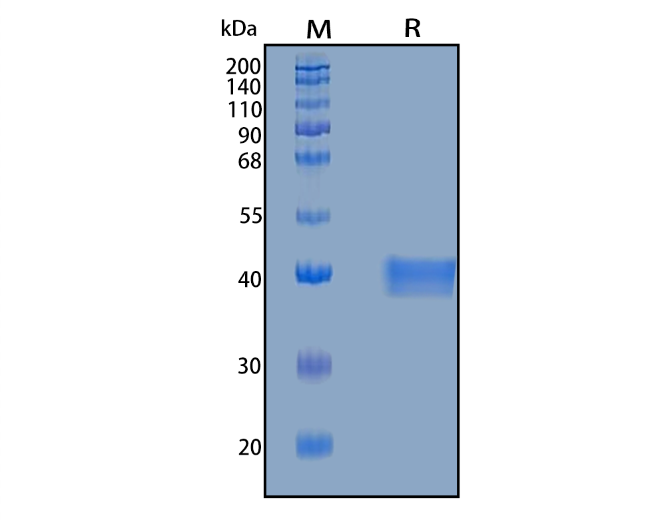
Analytical Data
-
Gene name
FASN
- Application
-
Alternative Names
FASN;Fatty acid synthase
-
Species
Human
-
Source
E. coli
-
Tag
N-terminal His Tag
-
Purity
Greater than 90% as determined by SDS-PAGE.
-
Uniprot
P49327
-
Expression Region
139-439aa
-
AA Sequence
MMANRLSFFFDFRGPSIALDTACSSSLMALQNAYQAIHSGQCPAAIVGGINVLL KPNTSVQFLRLGMLSPEGTCKAFDTAGNGYCRSEGVVAVLLTKKSLARRVYATI LNAGTNTDGFKEQGVTFPSGDIQEQLIRSLYQSAGVAPESFEYIEAHGTGTKVG DPQELNGITRALCATRQEPLLIGSTKSNMGHPEPASGLAALAKVLLSLEHGLWA PNLHFHSPNPEIPALLDGRLQVVDQPLPVRGGNVGINSFGFGGSNVHIILRPNT QPPPAPAPHATLPRLLRASGRTPEAVQKLLE
-
Molecular Weight
35.6kDa
-
Endotoxin
< 1.0 EU per μg protein as determined by the LAL method.
-
Form
Freeze-dried powder
-
Buffer formulation
PBS, pH7.4, containing 0.01% SKL, 1mM DTT, 5% Trehalose and Proclin300.
-
Reconstitution
Reconstitute in ddH2O to a concentration of 0.1-0.5 mg/mL. Do not vortex.
- Customization
-
Stability Test
The thermal stability is described by the loss rate. The loss rate was determined by accelerated thermal degradation test, that is, incubate the protein at 37℃ for 48h, and no obvious degradation and precipitation were observed. The loss rate isless than 8% within the expiration date under appropriate storage condition.
-
Storage & Shelf Life
Samples are stable for up to twelve months from date of receipt at -20℃ to -80℃. Store it under sterile conditions at -20℃ to -80℃. It is recommended that the protein be aliquoted for optimal storage. Avoid repeated freeze-thaw cycles.
-
Shipping
In general, recombinant proteins are supplied as lyophilized powder and shipped at ambient temperature. For bulk packages, the proteins are provided as frozen liquid and shipped with blue ice, unless otherwise requested by the customer.
Quality inspection process

Related Products
Identification
Protein Description
Fatty acid synthase (FASN) is a crucial enzyme involved in the de novo synthesis of fatty acids, playing a vital role in lipid metabolism and energy balance within cells. Its primary function is to catalyze the biosynthesis of long-chain fatty acids from acetyl-CoA and malonyl-CoA precursors through a series of enzymatic reactions. Dysregulation of FASN activity is linked to various pathological conditions, including obesity, insulin resistance, and cancer progression, making it an important target for therapeutic intervention. Research has revealed that FASN is often overexpressed in several tumor types, contributing to the enhanced lipid biosynthesis that fuels cancer cell growth and proliferation. Given its significance, scientists are focusing on developing FASN inhibitors as potential anti-cancer agents to suppress tumor growth by disrupting lipid metabolism. Additionally, studies on recombinant FASN proteins aim to elucidate the detailed mechanisms of fatty acid synthesis, enzyme kinetics, and the role of FASN in cellular signaling pathways. By utilizing recombinant DNA technology, researchers can produce FASN and its variants for structural and functional analyses, providing insights into its regulation and identifying novel inhibitory compounds. This research not only enhances the understanding of fatty acid metabolism but also paves the way for innovative strategies in cancer therapy and metabolic disease treatment.







