

Analytical Data
-
Gene name
PRR6
- Application
-
Alternative Names
3110013H01Rik; CENP V; CENP-V; Cenpv; CENPV_HUMAN; Centromere protein V; Nuclear protein p30; p30; Proline rich 6; Proline rich protein 6; Proline-rich protein 6; PRR6
-
Species
Human
-
Source
E. coli
-
Tag
His tag N-Terminus
-
Purity
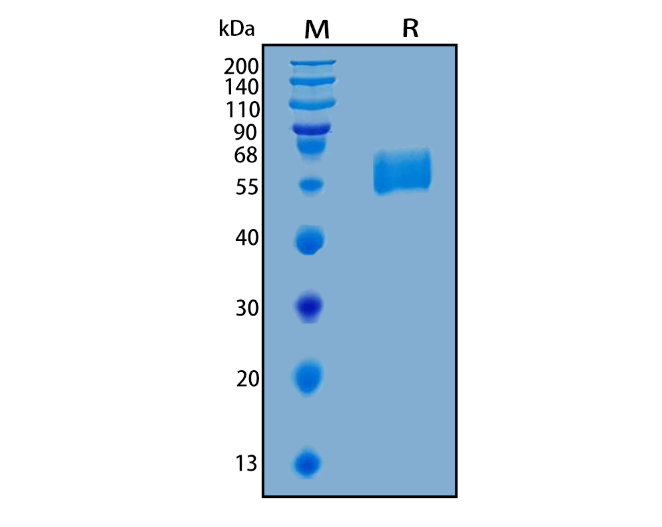
Greater than 90% as determined by SDS-PAGE.
-
Uniprot
Q7Z7K6
-
Expression Region
1-275 aa
-
AA Sequence
MRRSRSSAAA KLRGQKRSGA SGASAAPAAS AAAALAPSAT RTRRSASQAG SKSQAVEKPP SEKPRLRRSS PRAQEEGPGE PPPPELALLP PPPPPPPTPA TPTSSASNLD LGEQRERWET FQKRQKLTSE GAAKLLLDTF EYQGLVKHTG GCHCGAVRFE VWASADLHIF DCNCSICKKK QNRHFIVPAS RFKLLKGAEH ITTYTFNTHK AQHTFCKRCG VQSFYTPRSN PGGFGIAPHC LDEGTVRSMV TEEFNGSDWE KAMKEHKTIK NMSKE
-
Molecular Weight
29.9 kDa
-
Endotoxin
< 1.0 EU per μg protein as determined by the LAL method.
-
Form
Freeze-dried powder
-
Buffer formulation
PBS, pH7.4, containing 0.01% SKL, 1mM DTT, 5% Trehalose and Proclin300.
-
Reconstitution
Reconstitute in ddH2O to a concentration of 0.1-0.5 mg/mL. Do not vortex.
- Customization
-
Stability Test
The thermal stability is described by the loss rate. The loss rate was determined by accelerated thermal degradation test, that is, incubate the protein at 37℃ for 48h, and no obvious degradation and precipitation were observed. The loss rate isless than 8% within the expiration date under appropriate storage condition.
-
Storage & Shelf Life
Samples are stable for up to twelve months from date of receipt at -20℃ to -80℃. Store it under sterile conditions at -20℃ to -80℃. It is recommended that the protein be aliquoted for optimal storage. Avoid repeated freeze-thaw cycles.
-
Shipping
In general, recombinant proteins are supplied as lyophilized powder and shipped at ambient temperature. For bulk packages, the proteins are provided as frozen liquid and shipped with blue ice, unless otherwise requested by the customer.
Quality inspection process

Related Products
Protein Description
PRR6, or Pentatricopeptide Repeat Protein 6, is a member of the PPR protein family, which is known for its roles in post-transcriptional regulation of gene expression, particularly in organelles like mitochondria and plastids. Research into PRR6 has gained traction due to its involvement in crucial biological processes such as RNA editing, splicing, and translation. It is particularly significant in plants, where it plays a role in responses to environmental stress and developmental regulation. The study of PRR6 is also driven by its potential implications in improving crop resilience and productivity, especially under changing climate conditions. Understanding the molecular mechanisms of PRR6 can provide insights into its functional dynamics and interactions with other cellular components. Furthermore, as PPR proteins are known to be highly abundant and diverse in plant systems, elucidating the role of PRR6 can contribute to broader research aimed at unraveling the complex network of gene regulation in plant biology. As genetic engineering and biotechnological approaches advance, the exploration of PRR6 and its pathways may lead to novel strategies for enhancing plant traits, making it a focal point in plant molecular biology research.







