

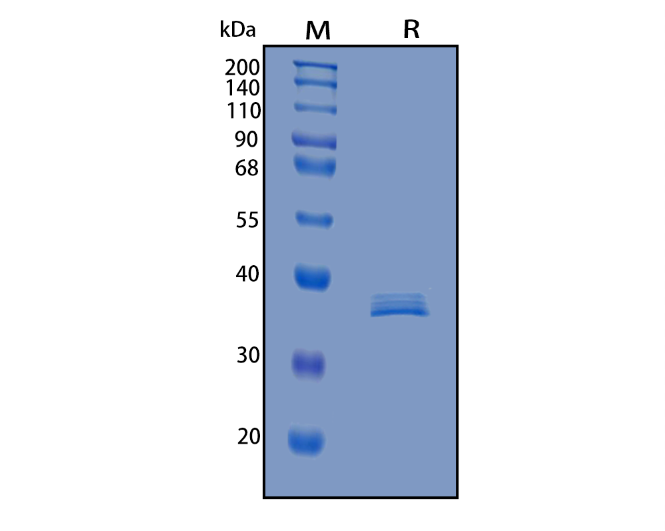
Analytical Data
-
Gene name
PPP1CA
- Application
-
Alternative Names
PPP1CA;PPP1A;Serine/threonine-Protein phosphatase PP1-alpha catalytic subunit
-
Species
Human
-
Source
E. coli
-
Tag
No Tags
-
Purity
Greater than 90% as determined by SDS-PAGE.
-
Uniprot
P62136
-
Expression Region
2-330aa
-
AA Sequence
SDSEKLNLD SIIGRLLEVQ GSRPGKNVQL TENEIRGLCL KSREIFLSQP ILLELEAPLK ICGDIHGQYY DLLRLFEYGG FPPESNYLFL GDYVDRGKQS LETICLLLAY KIKYPENFFL LRGNHECASI NRIYGFYDEC KRRYNIKLWK TFTDCFNCLP IAAIVDEKIF CCHGGLSPDL QSMEQIRRIM RPTDVPDQGL LCDLLWSDPD KDVQGWGEND RGVSFTFGAE VVAKFLHKHD LDLICRAHQV VEDGYEFFAK RQLVTLFSAP NYCGEFDNAG AMMSVDETLM CSFQILKPAD KNKGKYGQFS GLNPGGRPIT PPRNSAKAKK
-
Molecular Weight
37.4kDa
-
Endotoxin
< 1.0 EU per μg protein as determined by the LAL method.
-
Form
Freeze-dried powder
-
Buffer formulation
PBS, pH7.4, containing 0.01% Sarcosyl, 5% Trehalose .
-
Reconstitution
Reconstitute in ddH2O to a concentration of 0.1-0.5 mg/mL. Do not vortex.
- Customization
-
Stability Test
The thermal stability is described by the loss rate. The loss rate was determined by accelerated thermal degradation test, that is, incubate the protein at 37℃ for 48h, and no obvious degradation and precipitation were observed. The loss rate isless than 8% within the expiration date under appropriate storage condition.
-
Storage & Shelf Life
Samples are stable for up to twelve months from date of receipt at -20℃ to -80℃. Store it under sterile conditions at -20℃ to -80℃. It is recommended that the protein be aliquoted for optimal storage. Avoid repeated freeze-thaw cycles.
-
Shipping
In general, recombinant proteins are supplied as lyophilized powder and shipped at ambient temperature. For bulk packages, the proteins are provided as frozen liquid and shipped with blue ice, unless otherwise requested by the customer.
Quality inspection process

Related Products
Identification
Protein Description
PPP1CA, the gene encoding the catalytic subunit of protein phosphatase 1 (PP1), plays a crucial role in various cellular processes by modulating the phosphorylation state of serine and threonine residues on target proteins. Dysregulation of PPP1CA has been associated with multiple diseases, including cancer, neurodegenerative disorders, and cardiovascular diseases. As a key player in signaling pathways, PPP1CA is involved in important cellular functions such as cell division, apoptosis, and metabolism. Given its significance, researchers have focused on characterizing the structural and functional properties of PPP1CA through recombinant protein studies. The recombination approach allows for the production of large quantities of purified PPP1CA, facilitating detailed investigations into its enzymatic activity, substrate specificity, and interaction with regulatory proteins. Understanding the role of PPP1CA in health and disease can potentially lead to the development of targeted therapies that modulate its activity, offering new avenues for treatment in conditions where PP1 activity is altered. Thus, studies on PPP1CA recombinant protein not only contribute to the fundamental understanding of cellular signaling mechanisms but also hold promise for translational applications in medicine.







