

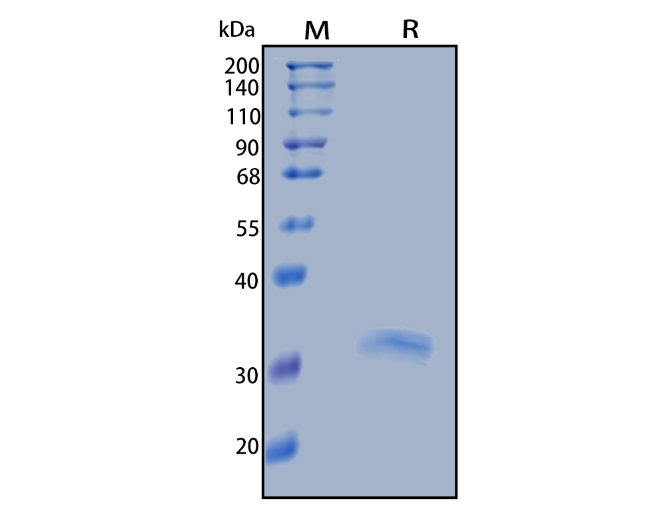
Analytical Data
-
Gene name
IFN-beta
- Application
-
Biological Activity
Measured in a cell cytotoxicity assay using TF-1 cells. The ED50 for this effect is 0.29-1.17 ng/mL, corresponding to a specific activity of 8.53×10⁵~3.41×10⁶ units/mg.
-
Alternative Names
IFNB1;IFB;IFNB;Interferon beta
-
Species
Human
-
Source
HEK293
-
Tag
C-His
-
Purity
Greater than 90% as determined by SDS-PAGE.
-
Uniprot
P01574
-
Expression Region
22-187aa
-
AA Sequence
MSYNLLGFLQRSSNFQCQKLLWQLNGRLEYCLKDRMNFDIPEEIKQLQQFQKEDAALTIYEMLQNIFAIFRQDSSSTGWNETIVENLLANVYHQINHLKTVLEEKLEKEDFTRGKLMSSLHLKRYYGRILHYLKAKEYSHCAWTIVRVEILRNFYFINRLTGYLRN
-
Molecular Weight
30 kDa
-
Endotoxin
< 1.0 EU per μg protein as determined by the LAL method.
-
Form
Freeze-dried powder
-
Buffer formulation
PBS, pH7.4, containing 0.01% SKL, 1mM DTT, 5% Trehalose and Proclin300.
-
Reconstitution
Reconstitute in ddH2O to a concentration of 0.1-0.5 mg/mL. Do not vortex.
- Customization
-
Stability Test
The thermal stability is described by the loss rate. The loss rate was determined by accelerated thermal degradation test, that is, incubate the protein at 37℃ for 48h, and no obvious degradation and precipitation were observed. The loss rate isless than 8% within the expiration date under appropriate storage condition.
-
Storage & Shelf Life
Samples are stable for up to twelve months from date of receipt at -20℃ to -80℃. Store it under sterile conditions at -20℃ to -80℃. It is recommended that the protein be aliquoted for optimal storage. Avoid repeated freeze-thaw cycles.
-
Shipping
In general, recombinant proteins are supplied as lyophilized powder and shipped at ambient temperature. For bulk packages, the proteins are provided as frozen liquid and shipped with blue ice, unless otherwise requested by the customer.
Quality inspection process

Related Products
Identification
Protein Description
IFNB1, or Interferon beta-1, is a crucial cytokine involved in the immune response, primarily recognized for its antiviral properties and role in modulating inflammation. Research into IFNB1 recombinant protein began in the context of its therapeutic potentials, especially for conditions like multiple sclerosis (MS) and certain viral infections. Given its ability to enhance the antiviral state of cells and regulate immune functions, scientists have focused on its recombinant form to overcome the challenges associated with natural sources, including variable potency and stability. Recombinant IFNB1 has been developed using various expression systems such as bacterial, yeast, and mammalian cell lines, allowing for more consistent production and improved bioactivity. These advances have enabled extensive clinical studies to evaluate IFNB1’s efficacy and safety profiles, leading to its approval as a treatment for MS and other inflammatory diseases. Moreover, ongoing research aims to optimize its formulation, delivery methods, and explore its potential in combination therapies, thus enhancing its therapeutic effectiveness. The pursuit of understanding IFNB1's mechanisms of action continues to provide insights, influencing the development of novel immunotherapies and expanding its applications in clinical settings.







