

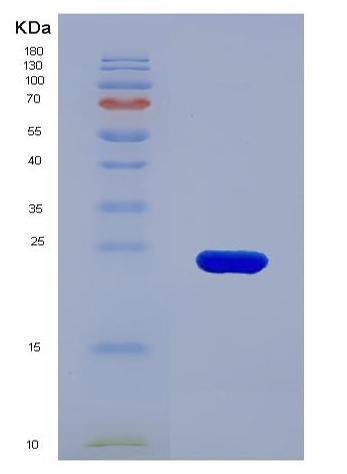
Analytical Data
-
Gene name
NGAL
- Application
-
Alternative Names
NGAL;HNL;NGAL;Neutrophil gelatinase-associated lipocalin
-
Species
Human
-
Source
E. coli
-
Tag
N-terminal His-Tag
-
Purity
Greater than 90% as determined by SDS-PAGE.
-
Uniprot
P80188
-
Expression Region
21-198aa
-
AA Sequence
QDSTSDLIPAPPLSKVPLQQNFQDNQFQGKWYVVGLAGNAILREDKDPQK MYATIYELKEDKSYNVTSVLFRKKKCDYWIRTFVPGCQPGEFTLGNIKSY PGLTSYLVRVVSTNYNQHAMVFFKKVSQNREYFKITLYGRTKELTSELKE NFIRFSKSLGLPENHIVFPVPIDQCIDG
-
Molecular Weight
24.4kDa
-
Endotoxin
< 1.0 EU per μg protein as determined by the LAL method.
-
Form
Freeze-dried powder
-
Buffer formulation
PBS, pH7.4, containing 0.01% SKL, 1mM DTT, 5% Trehalose and Proclin300.
-
Reconstitution
Reconstitute in ddH2O to a concentration of 0.1-0.5 mg/mL. Do not vortex.
- Customization
-
Stability Test
The thermal stability is described by the loss rate. The loss rate was determined by accelerated thermal degradation test, that is, incubate the protein at 37℃ for 48h, and no obvious degradation and precipitation were observed. The loss rate isless than 8% within the expiration date under appropriate storage condition.
-
Storage & Shelf Life
Samples are stable for up to twelve months from date of receipt at -20℃ to -80℃. Store it under sterile conditions at -20℃ to -80℃. It is recommended that the protein be aliquoted for optimal storage. Avoid repeated freeze-thaw cycles.
-
Shipping
In general, recombinant proteins are supplied as lyophilized powder and shipped at ambient temperature. For bulk packages, the proteins are provided as frozen liquid and shipped with blue ice, unless otherwise requested by the customer.
Quality inspection process

Related Products
Identification
Protein Description
Neutrophil gelatinase-associated lipocalin (NGAL) is a protein that has garnered significant attention in the field of biomedical research due to its role as a biomarker for acute kidney injury (AKI) and various inflammatory conditions. NGAL, expressed predominantly in neutrophils and various epithelial tissues, is released into the bloodstream and urine in response to tissue damage and stress, making it a promising indicator of kidney injury even in its early stages. Research into NGAL recombinant protein has focused on its potential in diagnostic and therapeutic applications. Studies have demonstrated that NGAL levels rise significantly during renal stress, allowing for early detection of AKI, which is crucial for timely intervention and treatment. Furthermore, the recombinant form of NGAL has been investigated for its protective effects in renal recovery, as it possesses anti-inflammatory properties and can modulate cellular responses to injury. There is also ongoing exploration of NGAL's role in various diseases, such as cardiovascular conditions and certain cancers, emphasizing its importance as a multifaceted biomarker. Additionally, recombinant NGAL is being studied for its potential use in drug delivery systems and as a vehicle for targeted therapies, potentially revolutionizing treatment approaches for kidney-related and systemic inflammatory diseases. Overall, the research into NGAL recombinant protein is paving the way for novel diagnostic tools and therapeutic strategies, highlighting its significance in the medical field.







