

Analytical Data
-
Gene name
BLNK
- Application
-
Alternative Names
BLNK;BASH;SLP65;B-cell linker Protein
-
Species
Human
-
Source
E. coli
-
Tag
His tag N-Terminus
-
Purity
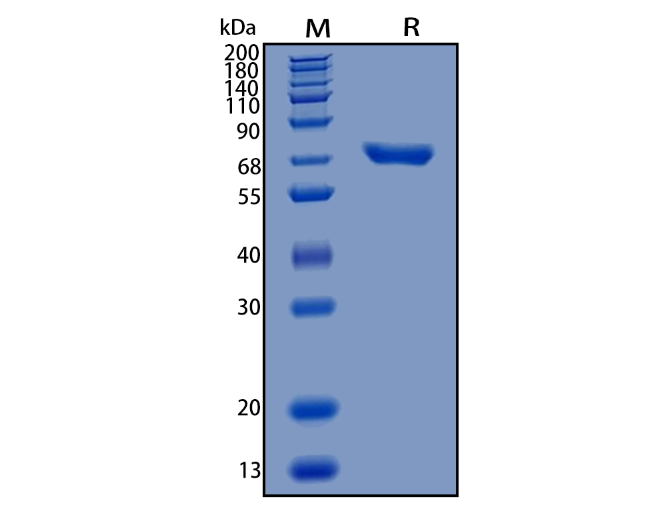
Greater than 90% as determined by SDS-PAGE.
-
Uniprot
Q8WV28
-
Expression Region
1-456aa
-
AA Sequence
MGSSHHHHHH SSGLVPRGSH MDKLNKITVP ASQKLRQLQK MVHDIKNNEG GIMNKIKKLK VKAPPSVPRR DYASESPADE EQQWSDDFDS DYENPDEHSD SEMYVMPAEE NADDSYEPPP VEQETRPVHP ALPFARGEYI DNRSSQRHSP PFSKTLPSKP SWPSEKARLT STLPALTALQ KPQVPPKPKG LLEDEADYVV PVEDNDENYI HPTESSSPPP EKAPMVNRST KPNSSTPASP PGTASGRNSG AWETKSPPPA APSPLPRAGK KPTTPLKTTP VASQQNASSV CEEKPIPAER HRGSSHRQEA VQSPVFPPAQ KQIHQKPIPL PRFTEGGNPT VDGPLPSFSS NSTISEQEAG VLCKPWYAGA CDRKSAEEAL HRSNKDGSFL IRKSSGHDSK QPYTLVVFFN KRVYNIPVRF IEATKQYALG RKKNGEEYFG SVAEIIRNHQ HSPLVLIDSQ NNTKDSTRLK YAVKVS
-
Molecular Weight
53 kDa
-
Endotoxin
< 1.0 EU per μg protein as determined by the LAL method.
-
Form
Freeze-dried powder
-
Buffer formulation
PBS, pH7.4, containing 0.01% SKL, 1mM DTT, 5% Trehalose and Proclin300.
-
Reconstitution
Reconstitute in ddH2O to a concentration of 0.1-0.5 mg/mL. Do not vortex.
- Customization
-
Stability Test
The thermal stability is described by the loss rate. The loss rate was determined by accelerated thermal degradation test, that is, incubate the protein at 37℃ for 48h, and no obvious degradation and precipitation were observed. The loss rate isless than 8% within the expiration date under appropriate storage condition.
-
Storage & Shelf Life
Samples are stable for up to twelve months from date of receipt at -20℃ to -80℃. Store it under sterile conditions at -20℃ to -80℃. It is recommended that the protein be aliquoted for optimal storage. Avoid repeated freeze-thaw cycles.
-
Shipping
In general, recombinant proteins are supplied as lyophilized powder and shipped at ambient temperature. For bulk packages, the proteins are provided as frozen liquid and shipped with blue ice, unless otherwise requested by the customer.
Quality inspection process

Related Products
Protein Description
BLNK (B-cell linker protein) is a critical adaptor protein involved in B-cell receptor signaling and plays a significant role in immune response regulation. It is primarily expressed in B lymphocytes and is essential for various cellular processes, including proliferation, differentiation, and survival of these immune cells. Research has shown that BLNK is crucial for the transmission of signals from the B-cell receptor to downstream signaling pathways, influencing the activation of other key molecules such as Bruton's tyrosine kinase (BTK) and phospholipase C-gamma (PLC-γ). Dysregulation of BLNK signaling has been implicated in various hematological malignancies and autoimmune disorders, highlighting its importance in maintaining immune homeostasis. Consequently, the study of BLNK protein and its functional domains has become a focal point in understanding the mechanisms underlying B-cell function and the pathogenesis of related diseases. Researchers are exploring the potential of BLNK as a therapeutic target, aiming to develop novel interventions that could modulate immune responses in conditions such as lymphoma, leukemia, and autoimmune diseases. The recombinant BLNK protein, therefore, serves as a valuable tool for these investigations, allowing scientists to dissect its biochemical properties, interactions, and ultimately its role in cellular signaling pathways. Through these studies, a deeper understanding of BLNK's function could lead to enhanced strategies for the treatment of immune-related conditions.







