

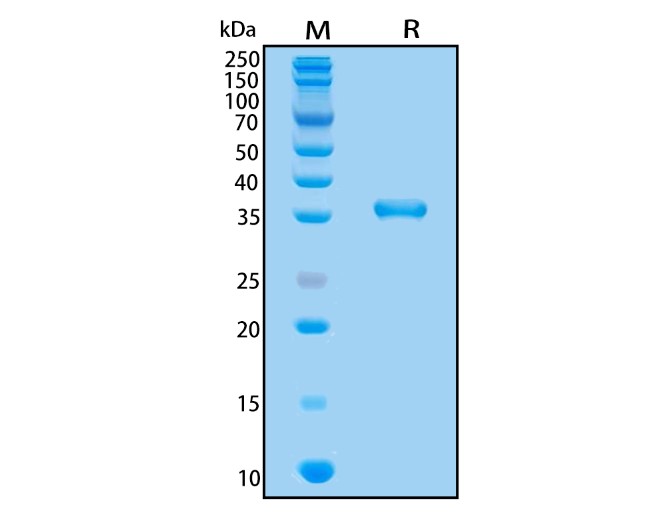
Analytical Data
-
Gene name
APOA5
- Application
-
Alternative Names
APOA5;RAP3;ApolipoProtein A-V
-
Species
Human
-
Source
E. coli
-
Tag
His tag N-Terminus
-
Purity
Greater than 90% as determined by SDS-PAGE.
-
Uniprot
Q96H31
-
Expression Region
24-366aa
-
AA Sequence
RKGFWDYFSQ TSGDKGRVEQ IHQQKMAREP ATLKDSLEQD LNNMNKFLEK LRPLSGSEAP RLPQDPVGMR RQLQEELEEV KARLQPYMAE AHELVGWNLE GLRQQLKPYT MDLMEQVALR VQELQEQLRV VGEDTKAQLL GGVDEAWALL QGLQSRVVHH TGRFKELFHP YAESLVSGIG RHVQELHRSV APHAPASPAR LSRCVQVLSR KLTLKAKALH ARIQQNLDQL REELSRAFAG TGTEEGAGPD PQMLSEEVRQ RLQAFRQDTY LQIAAFTRAI DQETEEVQQQ LAPPPPGHSA FAPEFQQTDS GKVLSKLQAR LDDLWEDITH SLHDQGHSHL GDPAAADYKD DDDK
-
Molecular Weight
40 kDa
-
Endotoxin
< 1.0 EU per μg protein as determined by the LAL method.
-
Form
Freeze-dried powder
-
Buffer formulation
PBS, pH7.4, containing 0.01% SKL, 1mM DTT, 5% Trehalose and Proclin300.
-
Reconstitution
Reconstitute in ddH2O to a concentration of 0.1-0.5 mg/mL. Do not vortex.
- Customization
-
Stability Test
The thermal stability is described by the loss rate. The loss rate was determined by accelerated thermal degradation test, that is, incubate the protein at 37℃ for 48h, and no obvious degradation and precipitation were observed. The loss rate isless than 8% within the expiration date under appropriate storage condition.
-
Storage & Shelf Life
Samples are stable for up to twelve months from date of receipt at -20℃ to -80℃. Store it under sterile conditions at -20℃ to -80℃. It is recommended that the protein be aliquoted for optimal storage. Avoid repeated freeze-thaw cycles.
-
Shipping
In general, recombinant proteins are supplied as lyophilized powder and shipped at ambient temperature. For bulk packages, the proteins are provided as frozen liquid and shipped with blue ice, unless otherwise requested by the customer.
Quality inspection process

Related Products
Protein Description
Apolipoprotein A5 (APOA5) plays a critical role in the regulation of lipid metabolism and is associated with triglyceride levels and cardiovascular disease risk. Initially identified as a key component of chylomicrons and very-low-density lipoproteins (VLDL), APOA5 has garnered significant attention in recent years due to its genetic variants linked to dyslipidemia, which can lead to atherosclerosis and other metabolic disorders. Research indicates that APOA5 contributes to the modulation of lipid transfer and clearance, acting by influencing lipoprotein formation and metabolism. The recombinant expression of APOA5 in various systems has provided insights into its structure-function relationships, revealing how it interacts with other proteins and lipids to exert its effects on triglyceride homeostasis. Studies utilizing recombinant APOA5 have advanced our understanding of its potential therapeutic applications, including the development of strategies aimed at mitigating hypertriglyceridemia and associated cardiovascular risks. With the rising prevalence of metabolic syndrome globally, investigating the functional characteristics and mechanisms of action of APOA5 remains pivotal for developing novel interventions targeting lipid-related disorders. Future research in this area will likely focus on elucidating the precise signaling pathways involved and exploring the potential of recombinant APOA5 as a biomarker or therapeutic agent in cardiovascular and metabolic diseases.







