

Analytical Data
-
Gene name
PLY
-
简介
The PLY protein, a cholesterol-dependent toxin, induces cytolysis by forming pores in host membranes with a significant conformational change and oligomeric pore complex formation. Cholesterol is crucial for binding, insertion, and pore formation. PLY Protein, Streptococcus pneumoniae serotype 4 is the recombinant others-derived PLY protein, expressed by E. coli, with tag free.
- Application
-
Alternative Names
ply; SP_1923; Pneumolysin; Ply; Thiol-activated cytolysin
-
Species
Others
-
Source
E. coli
-
Tag
Tag Free
-
Purity
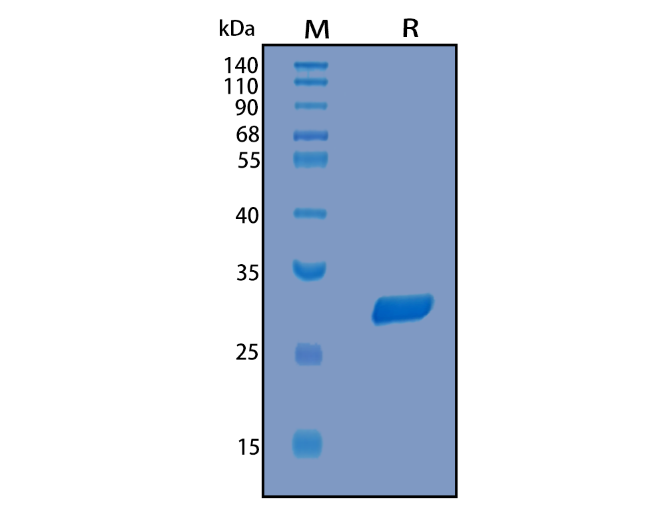
Greater than 90% as determined by SDS-PAGE.
-
Uniprot
P0C2J9
-
Expression Region
A2-D471
-
AA Sequence
ANKAVNDFILAMNYDKKKLLTHQGESIENRFIKEGNQLPDEFVVIERKKRSLSTNTSDISVTATNDSRLYPGALLVVDETLLENNPTLLAVDRAPMTYSIDLPGLASSDSFLQVEDPSNSSVRGAVNDLLAKWHQDYGQVNNVPARMQYEKITAHSMEQLKVKFGSDFEKTGNSLDIDFNSVHSGEKQIQIVNFKQIYYTVSVDAVKNPGDVFQDTVTVEDLKQRGISAERPLVYISSVAYGRQVYLKLETTSKSDEVEAAFEALIKGVKVAPQTEWKQILDNTEVKAVILGGDPSSGARVVTGKVDMVEDLIQEGSRFTADHPGLPISYTTSFLRDNVVATFQNSTDYVETKVTAYRNGDLLLDHSGAYVAQYYITWNELSYDHQGKEVLTPKAWDRNGQDLTAHFTTSIPLKGNVRNLSVKIRECTGLAWEWWRTVYEKTDLPLVRKRTISIWGTTLYPQVEDKVEND
-
Protein Length
Full Length of Mature Protein
-
Molecular Weight
45-50 kDa
-
Endotoxin
< 1.0 EU per μg protein as determined by the LAL method.
-
Form
Freeze-dried powder
-
Buffer formulation
PBS, pH7.4, containing 0.01% SKL, 1mM DTT, 5% Trehalose and Proclin300.
-
Reconstitution
Reconstitute in ddH2O to a concentration of 0.1-0.5 mg/mL. Do not vortex.
- Customization
-
Stability Test
The thermal stability is described by the loss rate. The loss rate was determined by accelerated thermal degradation test, that is, incubate the protein at 37℃ for 48h, and no obvious degradation and precipitation were observed. The loss rate isless than 8% within the expiration date under appropriate storage condition.
-
Storage & Shelf Life
Samples are stable for up to twelve months from date of receipt at -20℃ to -80℃. Store it under sterile conditions at -20℃ to -80℃. It is recommended that the protein be aliquoted for optimal storage. Avoid repeated freeze-thaw cycles.
-
Shipping
In general, recombinant proteins are supplied as lyophilized powder and shipped at ambient temperature. For bulk packages, the proteins are provided as frozen liquid and shipped with blue ice, unless otherwise requested by the customer.
Quality inspection process

Related Products
Protein Description
The study of PLY (Plyolysin) recombinant proteins has gained significant attention within the field of microbiology and immunology due to their potential applications in vaccine development and therapeutic interventions. PLY, a pore-forming toxin produced by Streptococcus pneumoniae, plays a crucial role in the pathogenicity of this bacterium, contributing to its virulence and the severity of pneumococcal diseases. Researchers have focused on understanding the structural and functional characteristics of PLY to exploit its properties for biomedical purposes. Recombinant techniques allow for the production of PLY in a controlled environment, facilitating the investigation of its immunogenic properties and its potential as an adjuvant in vaccine formulations. Moreover, studies have shown that PLY can enhance the immune response against co-administered antigens, making it an attractive candidate for use in combination vaccines targeting multiple pathogens. The exploration of PLY's mechanism of action also provides insights into bacterial pathogenesis and hosts' immune responses, paving the way for novel therapeutic strategies against pneumococcal infections and other diseases associated with pore-forming toxins. Overall, the research on PLY recombinant proteins represents a promising frontier in both understanding bacterial virulence and advancing public health through innovative vaccine development.







