

Analytical Data
-
Gene name
BirA
- Application
-
Alternative Names
Bifunctional ligase/repressor BirA; birA; bioR; dhbB
-
Species
E.coli
-
Source
E. coli
-
Tag
N-6*His;N-MBP
-
Purity
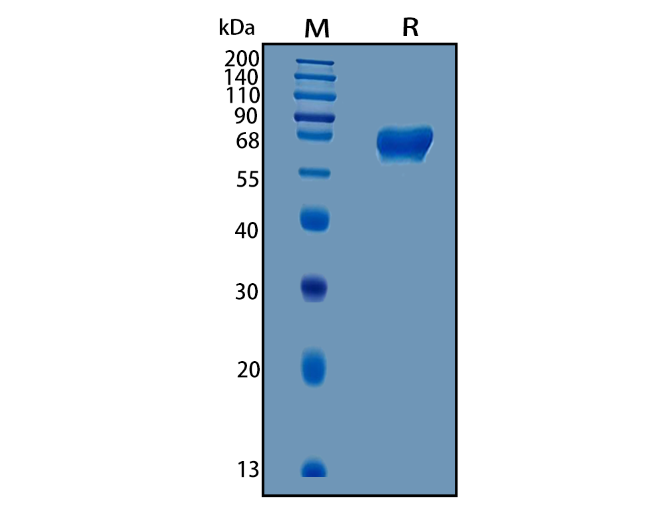
Greater than 95% as determined by SDS-PAGE.
-
Uniprot
P06709
-
Expression Region
M1-K321
-
AA Sequence
MKDNTVPLKLIALLANGEFHSGEQLGETLGMSRAAINKHIQTLRDWGVDVFTVPGKGYSLPEPIQLLNAKQILGQLDGGSVAVLPVIDSTNQYLLDRIGELKSGDACIAEYQQAGRGRRGRKWFSPFGANLYLSMFWRLEQGPAAAIGLSLVIGIVMAEVLRKLGADKVRVKWPNDLYLQDRKLAGILVELTGKTGDAAQIVIGAGINMAMRRVEESVVNQGWITLQEAGINLDRNTLAAMLIRELRAALELFEQEGLAPYLSRWEKLDNFINRPVKLIIGDKEIFGISRGIDKQGALLLEQDGIIKPWMGGEISLRSAEK
-
Protein Length
Full Length
-
Molecular Weight
64-77 kDa
-
Endotoxin
< 1.0 EU per μg protein as determined by the LAL method.
-
Form
Freeze-dried powder
-
Buffer formulation
PBS, pH7.4, containing 0.01% SKL, 1mM DTT, 5% Trehalose and Proclin300.
-
Reconstitution
Reconstitute in ddH2O to a concentration of 0.1-0.5 mg/mL. Do not vortex.
- Customization
-
Stability Test
The thermal stability is described by the loss rate. The loss rate was determined by accelerated thermal degradation test, that is, incubate the protein at 37℃ for 48h, and no obvious degradation and precipitation were observed. The loss rate isless than 8% within the expiration date under appropriate storage condition.
-
Storage & Shelf Life
Samples are stable for up to twelve months from date of receipt at -20℃ to -80℃. Store it under sterile conditions at -20℃ to -80℃. It is recommended that the protein be aliquoted for optimal storage. Avoid repeated freeze-thaw cycles.
-
Shipping
In general, recombinant proteins are supplied as lyophilized powder and shipped at ambient temperature. For bulk packages, the proteins are provided as frozen liquid and shipped with blue ice, unless otherwise requested by the customer.
Quality inspection process

Related Products
Protein Description
BirA is a biotin ligase enzyme that is pivotal in the study of protein labeling and tracking within biological systems. It facilitates the attachment of biotin to proteins in a process known as biotinylation, which allows researchers to investigate protein interactions, localization, and dynamics in living cells. The ability of BirA to selectively label proteins with biotin has led to the development of advanced methodologies, such as biotin-avidin pull-down assays and tethered interactions studies, enhancing our understanding of molecular complexes within various cellular contexts. Moreover, BirA’s utility extends to applications in synthetic biology and therapeutic development, where precise control over protein functionality is crucial. The exploration of BirA and its variants focuses on improving labeling efficiency, specificity, and minimal interference with the native functions of proteins. In recent years, advancements in genetic engineering and molecular design have enabled the optimization of BirA for a broader range of applications, making it a valuable tool in contemporary biochemical research. This ongoing research contributes to elucidating the complexities of cellular mechanisms and holds promise for innovations in biotechnology and medicine.







