

Analytical Data
-
Gene name
PNGase F
-
简介
The PNGase F protein acts as an enzyme catalyst that specifically cleaves entire glycans from glycoproteins. This process depends on the replacement of the glycosylated asparagine moiety by a polypeptide chain at both its amino (R1) and carboxyl (R2) termini, as shown in Reaction 1. PNGase F Protein, F. meningosepticum (His) is the recombinant PNGase F protein, expressed by E. coli , with N-His labeled tag.
- Application
-
Alternative Names
PNGase F; PNGF; Peptide-N4-(N-acetyl-beta-D-glucosaminyl)asparagine Amidase F
-
Species
Others
-
Source
E. coli
-
Tag
N-6*His
-
Purity
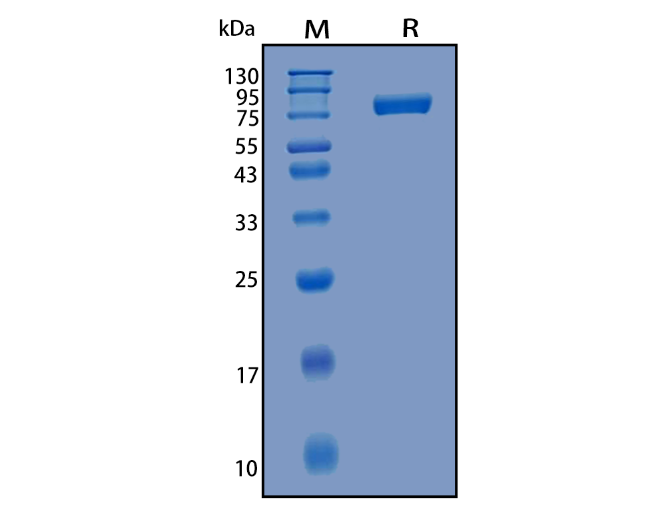
Greater than 95% as determined by SDS-PAGE.
-
Uniprot
P21163
-
Expression Region
A41-N354
-
AA Sequence
APADNTVNIKTFDKVKNAFGDGLSQSAEGTFTFPADVTTVKTIKMFIKNECPNKTCDEWDRYANVYVKNKTTGEWYEIGRFITPYWVGTEKLPRGLEIDVTDFKSLLSGNTELKIYTETWLAKGREYSVDFDIVYGTPDYKYSAVVPVIQYNKSSIDGVPYGKAHTLGLKKNIQLPTNTEKAYLRTTISGWGHAKPYDAGSRGCAEWCFRTHTIAINNANTFQHQLGALGCSANPINNQSPGNWAPDRAGWCPGMAVPTRIDVLNNSLTGSTFSYEYKFQSWTNNGTNGDAFYAISSFVIAKSNTPISAPVVTN
-
Protein Length
Full Length of Mature Protein
-
Molecular Weight
35 kDa
-
Endotoxin
< 1.0 EU per μg protein as determined by the LAL method.
-
Form
Freeze-dried powder
-
Buffer formulation
PBS, pH7.4, containing 0.01% SKL, 1mM DTT, 5% Trehalose and Proclin300.
-
Reconstitution
Reconstitute in ddH2O to a concentration of 0.1-0.5 mg/mL. Do not vortex.
- Customization
-
Stability Test
The thermal stability is described by the loss rate. The loss rate was determined by accelerated thermal degradation test, that is, incubate the protein at 37℃ for 48h, and no obvious degradation and precipitation were observed. The loss rate isless than 8% within the expiration date under appropriate storage condition.
-
Storage & Shelf Life
Samples are stable for up to twelve months from date of receipt at -20℃ to -80℃. Store it under sterile conditions at -20℃ to -80℃. It is recommended that the protein be aliquoted for optimal storage. Avoid repeated freeze-thaw cycles.
-
Shipping
In general, recombinant proteins are supplied as lyophilized powder and shipped at ambient temperature. For bulk packages, the proteins are provided as frozen liquid and shipped with blue ice, unless otherwise requested by the customer.
Quality inspection process

Related Products
Protein Description
PNGase F, or Peptide-N4-(N-acetyl-β-glucosaminyl) asparagine amidase F, is an important glycosidase enzyme derived from the bacterium Elizabethkingia miricola. Its primary function is to cleave the N-glycans from glycoproteins, specifically targeting the bond between the asparagine residue and the N-acetylglucosamine moiety. The relevance of PNGase F has grown significantly in biomedicine and biotechnology due to its potential applications in glycoprotein analysis and therapeutic glycoprotein production. As the demand for biopharmaceuticals continues to rise, understanding the structural and functional properties of recombinant PNGase F enables researchers to utilize it effectively for the deglycosylation of proteins. This is crucial for both the characterization of glycoproteins and the enhancement of their therapeutic efficacy by improving drug stability and bioavailability. Recent advancements in recombinant DNA technology have facilitated the production of PNGase F in large quantities, allowing for detailed studies on its mechanism and specificity. Moreover, the enzyme's ability to function optimally under various conditions makes it a versatile tool in glycoproteomics. Ongoing research aims to explore the enzyme's potential for industrial applications, such as biocatalysis and bioprocessing in the production of glycosylated products. The continued investigation into PNGase F is expected to contribute significantly to advancements in glycoscience, aiding in the development of novel therapeutic strategies and improving existing biopharmaceuticals by leveraging its unique enzymatic properties.







