

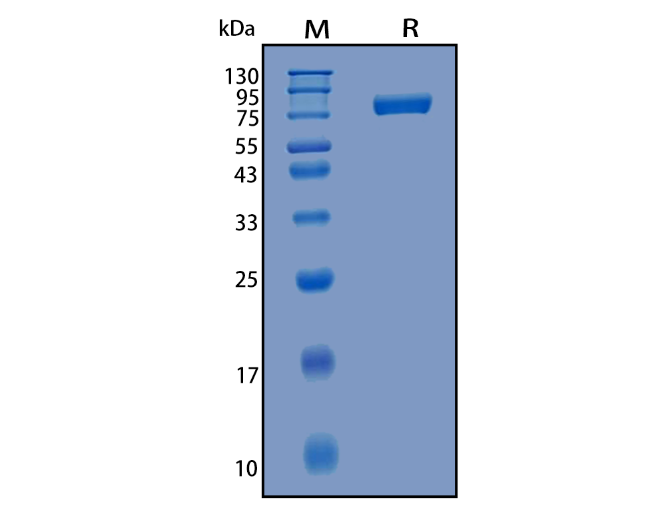
Analytical Data
-
Gene name
Heparanase/HPSE
- Application
-
Biological Activity
1.The enzyme activity of this recombinant protein is testing in progress, we cannot offer a guarantee yet. 2.Measured by its binding ability in a functional ELISA. Immobilized HPSE at 2 μg/ml (100μl/well) can bind HPSE antibody. The ED50 for this effect is 0.2357 μg/mL. Measured by its binding ability in a functional ELISA. Immobilized HPSE at 2 μg/ml (100μl/well) can bind HPSE antibody. The ED50 for this effect is 0.2357 μg/mL.
-
Alternative Names
Heparanase; Endo-glucoronidase; Heparanase-1; Hpa1; HEP, HPA, HPA1, HPR1, HPSE1, HSE1; HPSE
-
Species
Human
-
Source
CHO
-
Tag
N-6*His
-
Purity
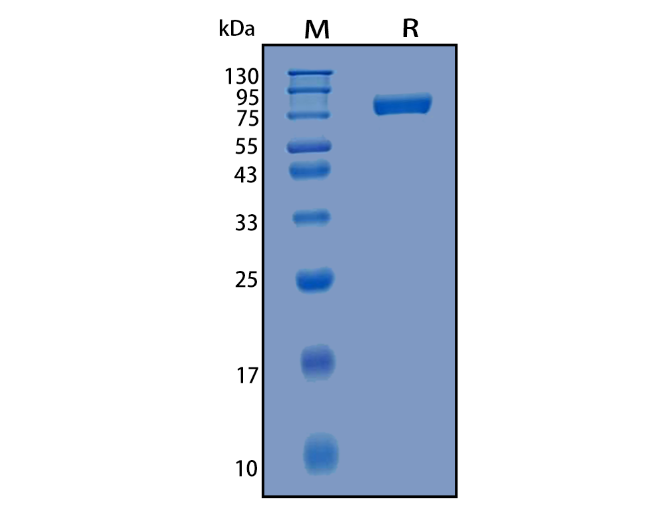
Greater than 95% as determined by SDS-PAGE.
-
Uniprot
AAD41342.1
-
Expression Region
Q36-I543
-
Protein Length
Full length of Mature Protein
-
Molecular Weight
78 kDa
-
Endotoxin
< 1.0 EU per μg protein as determined by the LAL method.
-
Form
Freeze-dried powder
-
Buffer formulation
PBS, pH7.4, containing 0.01% SKL, 1mM DTT, 5% Trehalose and Proclin300.
-
Reconstitution
Reconstitute in ddH2O to a concentration of 0.1-0.5 mg/mL. Do not vortex.
- Customization
-
Stability Test
The thermal stability is described by the loss rate. The loss rate was determined by accelerated thermal degradation test, that is, incubate the protein at 37℃ for 48h, and no obvious degradation and precipitation were observed. The loss rate isless than 8% within the expiration date under appropriate storage condition.
-
Storage & Shelf Life
Samples are stable for up to twelve months from date of receipt at -20℃ to -80℃. Store it under sterile conditions at -20℃ to -80℃. It is recommended that the protein be aliquoted for optimal storage. Avoid repeated freeze-thaw cycles.
-
Shipping
In general, recombinant proteins are supplied as lyophilized powder and shipped at ambient temperature. For bulk packages, the proteins are provided as frozen liquid and shipped with blue ice, unless otherwise requested by the customer.
Quality inspection process

Related Products
Identification
Protein Description
Heparanase (HPSE) is an endo-β-glucuronidase enzyme responsible for the degradation of heparan sulfate, a key component of the extracellular matrix and cell surface proteoglycans. It plays a crucial role in various physiological and pathological processes, including tumor progression, angiogenesis, and inflammation. Elevated HPSE levels have been associated with aggressive cancer phenotypes, making it a potential therapeutic target for cancer treatment. Research into recombinant HPSE has gained significant attention due to its potential applications in understanding the enzyme's biological functions and developing new therapeutic strategies. Recombinant HPSE can be produced using various expression systems, enabling studies on its enzymatic activity, substrate specificity, and interaction with other biomolecules. Moreover, insights gained from recombinant protein studies can aid in designing HPSE inhibitors, which could serve as novel anti-cancer agents. The exploration of HPSE's role in the tumor microenvironment and its implications in metastasis further highlights its significance in cancer research, necessitating an ongoing investigation into its molecular mechanisms and potential as a biomarker for cancer prognosis. Overall, the study of recombinant heparanase is critical for devising innovative therapeutic approaches to target malignancies and improve patient outcomes.







