

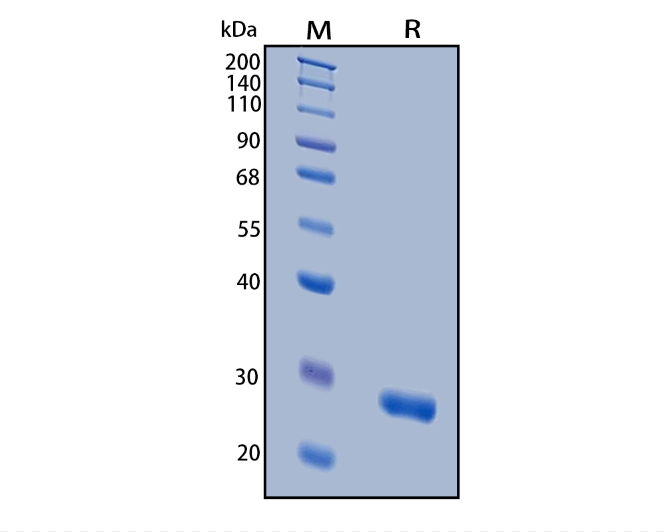
Analytical Data
-
Gene name
SCF
- Application
-
Biological Activity
Measured in a cell proliferation assay using TF‑ 1 human erythroleukemic cells. The ED50 forthis effect is 1.00-8.00 ng/mL.
-
Alternative Names
KITLG;MGF;SCF;Kit ligand
-
Species
Human
-
Source
HEK293
-
Tag
C-His
-
Purity
Greater than 90% as determined by SDS-PAGE.
-
Uniprot
P21583-1
-
Expression Region
26-214aa
-
Molecular Weight
22 kDa
-
Endotoxin
< 1.0 EU per μg protein as determined by the LAL method.
-
Form
Freeze-dried powder
-
Buffer formulation
PBS, pH7.4, containing 0.01% SKL, 1mM DTT, 5% Trehalose and Proclin300.
-
Reconstitution
Reconstitute in ddH2O to a concentration of 0.1-0.5 mg/mL. Do not vortex.
- Customization
-
Stability Test
The thermal stability is described by the loss rate. The loss rate was determined by accelerated thermal degradation test, that is, incubate the protein at 37℃ for 48h, and no obvious degradation and precipitation were observed. The loss rate isless than 8% within the expiration date under appropriate storage condition.
-
Storage & Shelf Life
Samples are stable for up to twelve months from date of receipt at -20℃ to -80℃. Store it under sterile conditions at -20℃ to -80℃. It is recommended that the protein be aliquoted for optimal storage. Avoid repeated freeze-thaw cycles.
-
Shipping
In general, recombinant proteins are supplied as lyophilized powder and shipped at ambient temperature. For bulk packages, the proteins are provided as frozen liquid and shipped with blue ice, unless otherwise requested by the customer.
Quality inspection process

Related Products
Identification
Protein Description
The study of Suprachiasmatic Nucleus Circadian Factor (SCF) recombinant proteins has gained significant attention due to their critical role in regulating circadian rhythms and physiological processes in various organisms. SCF proteins are integral to understanding the molecular mechanisms underlying circadian clock functions, influencing behaviors such as sleep-wake cycles, hormone secretion, and metabolism. Research has explored the structure-function relationship of SCF proteins to identify their interactions with key molecular partners within the circadian pathway. Advances in recombinant DNA technology have allowed for the production of these proteins in engineered systems, facilitating detailed studies of their biochemical properties and functional assays. The ability to manipulate SCF proteins has proven pivotal in elucidating the complex genetic and environmental factors that govern circadian rhythms, with implications for health and disease, including sleep disorders, metabolic syndromes, and mood disorders. Researchers have also been investigating potential therapeutic strategies targeting SCF pathways to restore circadian function disrupted by various factors. Overall, the exploration of SCF recombinant proteins represents a promising frontier in chronobiology, with far-reaching consequences for understanding and treating conditions influenced by circadian misalignment.







