

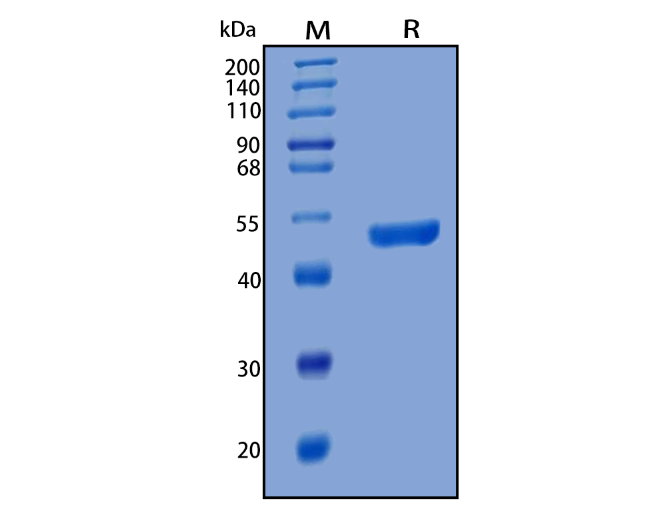
Analytical Data
-
Gene name
GNAS2
- Application
-
Alternative Names
3D-structure ADP-ribosylation Alternative splicing Cell membrane Cushing syndrome Direct protein sequencing Disease variant Dwarfism GTP-binding Hydrolase Isopeptide bond Lipoprotein Magnesium Membrane Metal-binding Nucleotide-binding Obesity Palmitate Ph
-
Species
Human
-
Source
E. coli
-
Tag
His Tag
-
Purity
Greater than 90% as determined by SDS-PAGE.
-
Uniprot
P63092
-
Expression Region
2-394aa
-
Molecular Weight
44kDa
-
Endotoxin
< 1.0 EU per μg protein as determined by the LAL method.
-
Form
Freeze-dried powder
-
Buffer formulation
PBS, pH7.4, containing 0.01% SKL, 1mM DTT, 5% Trehalose and Proclin300.
-
Reconstitution
Reconstitute in ddH2O to a concentration of 0.1-0.5 mg/mL. Do not vortex.
- Customization
-
Stability Test
The thermal stability is described by the loss rate. The loss rate was determined by accelerated thermal degradation test, that is, incubate the protein at 37℃ for 48h, and no obvious degradation and precipitation were observed. The loss rate isless than 8% within the expiration date under appropriate storage condition.
-
Storage & Shelf Life
Samples are stable for up to twelve months from date of receipt at -20℃ to -80℃. Store it under sterile conditions at -20℃ to -80℃. It is recommended that the protein be aliquoted for optimal storage. Avoid repeated freeze-thaw cycles.
-
Shipping
In general, recombinant proteins are supplied as lyophilized powder and shipped at ambient temperature. For bulk packages, the proteins are provided as frozen liquid and shipped with blue ice, unless otherwise requested by the customer.
Quality inspection process

Related Products
Identification
Protein Description
The PIK3CA gene encodes the p110α subunit of phosphoinositide 3-kinase (PI3K), a crucial enzyme that regulates various cellular processes, including growth, proliferation, and survival. Mutations in PIK3CA are frequently associated with several cancers, making it a significant target for oncological research. These mutations lead to aberrant activation of the PI3K/Akt signaling pathway, contributing to tumorigenesis and cancer progression. Given that PIK3CA mutations are prevalent in breast cancer, colorectal cancer, and other malignancies, understanding the structure and function of PIK3CA recombinant proteins is vital for elucidating the molecular mechanisms of these cancers. Research on recombinant PIK3CA proteins enables the study of protein interactions, signaling pathways, and the effects of specific mutations, thereby facilitating the development of targeted therapies. Additionally, recombinant proteins serve as valuable tools in drug discovery, allowing researchers to identify inhibitors that can disrupt the signaling cascade initiated by mutated PIK3CA. Overall, focused studies on PIK3CA recombinant proteins contribute significantly to the advancement of personalized cancer therapies and the identification of effective treatment strategies for patients harboring PIK3CA mutations.







