

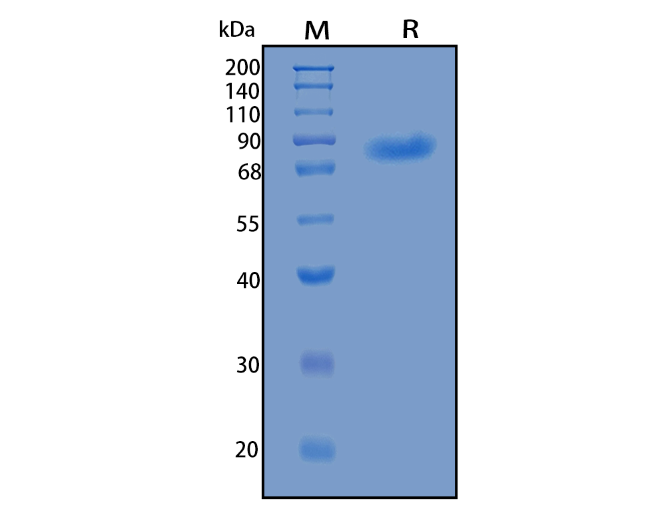
Analytical Data
-
Gene name
TRIM25
- Application
-
Alternative Names
E3 ubiquitin/ISG15 ligase TRIM25; EFP; Estrogen responsive finger Protein; Estrogen-responsive finger Protein; RING finger Protein 147; RNF 147; RNF147; TRI25; TRI25_HUMAN; TRIM 25; Trim25; Tripartite motif containing 25; Tripartite motif containing Protein 25; Tripartite motif Protein TRIM25; Tripartite motif-containing Protein 25; Tripartite motifcontaining25; Ubiquitin/ISG15-conjugating enzyme TRIM25; Z147; Zinc finger Protein 147 (estrogen responsive finger Protein); Zinc finger Protein 147; Zinc finger Protein-147; ZNF 147; ZNF147
-
Species
Human
-
Source
E. coli
-
Tag
N-terminalHisandKSITag
-
Purity
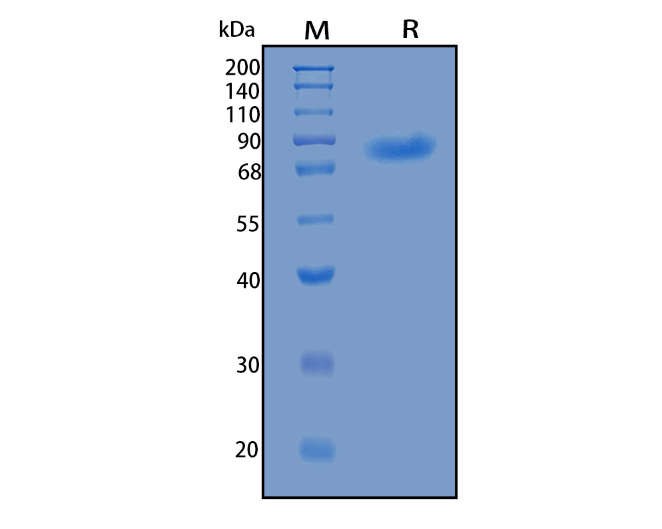
Greater than 90% as determined by SDS-PAGE.
-
Uniprot
Q14258
-
Expression Region
1-630 aa
-
AA Sequence
MAELCPLAEE LSCSICLEPF KEPVTTPCGH NFCGSCLNET WAVQGSPYLC PQCRAVYQAR PQLHKNTVLC NVVEQFLQAD LAREPPADVW TPPARASAPS PNAQVACDHC LKEAAVKTCL VCMASFCQEH LQPHFDSPAF QDHPLQPPVR DLLRRKCSQH NRLREFFCPE HSECICHICL VEHKTCSPAS LSQASADLEA TLRHKLTVMY SQINGASRAL DDVRNRQQDV RMTANRKVEQ LQQEYTEMKA LLDASETTST RKIKEEEKRV NSKFDTIYQI LLKKKSEIQT LKEEIEQSLT KRDEFEFLEK ASKLRGISTK PVYIPEVELN HKLIKGIHQS TIDLKNELKQ CIGRLQEPTP SSGDPGEHDP ASTHKSTRPV KKVSKEEKKS KKPPPVPALP SKLPTFGAPE QLVDLKQAGL EAAAKATSSH PNSTSLKAKV LETFLAKSRP ELLEYYIKVI LDYNTAHNKV ALSECYTVAS VAEMPQNYRP HPQRFTYCSQ VLGLHCYKKG IHYWEVELQK NNFCGVGICY GSMNRQGPES RLGRNSASWC VEWFNTKISA WHNNVEKTLP STKATRVGVL LNCDHGFVIF FAVADKVHLM YKFRVDFTEA LYPAFWVFSA GATLSICSPK
-
Molecular Weight
85.9kDa
-
Endotoxin
< 1.0 EU per μg protein as determined by the LAL method.
-
Form
Freeze-dried powder
-
Buffer formulation
PBS, pH7.4, containing 0.01% SKL, 1mM DTT, 5% Trehalose and Proclin300.
-
Reconstitution
Reconstitute in ddH2O to a concentration of 0.1-0.5 mg/mL. Do not vortex.
- Customization
-
Stability Test
The thermal stability is described by the loss rate. The loss rate was determined by accelerated thermal degradation test, that is, incubate the protein at 37℃ for 48h, and no obvious degradation and precipitation were observed. The loss rate isless than 8% within the expiration date under appropriate storage condition.
-
Storage & Shelf Life
Samples are stable for up to twelve months from date of receipt at -20℃ to -80℃. Store it under sterile conditions at -20℃ to -80℃. It is recommended that the protein be aliquoted for optimal storage. Avoid repeated freeze-thaw cycles.
-
Shipping
In general, recombinant proteins are supplied as lyophilized powder and shipped at ambient temperature. For bulk packages, the proteins are provided as frozen liquid and shipped with blue ice, unless otherwise requested by the customer.
Quality inspection process

Related Products
Identification
Protein Description
TRIM25, a member of the tripartite motif (TRIM) family of proteins, has emerged as a significant player in various biological processes, including immune response, cell proliferation, and differentiation. Structurally characterized by its RING finger, B-box, and coiled-coil domains, TRIM25 functions as an E3 ubiquitin ligase, facilitating the ubiquitination of target proteins and influencing their stability and activity. Research has revealed that TRIM25 plays a crucial role in antiviral immunity by promoting the ubiquitination and activation of key signaling pathways, such as the RIG-I-like receptor (RLR) pathway, which is essential for the recognition of viral RNA. Dysregulation of TRIM25 activity has been implicated in various diseases, including cancers and autoimmune disorders, highlighting its potential as a therapeutic target. The recombinant expression of TRIM25 provides a valuable tool for elucidating its functional roles and regulatory mechanisms, allowing for detailed studies on its interaction with other proteins and its impact on cellular signaling pathways. Understanding the biological significance of TRIM25 through recombinant protein research can pave the way for innovative treatments and interventions in diseases where its function is compromised or aberrantly activated. Thus, the exploration of TRIM25’s properties and its recombinant protein applications holds significant promise for advancing our knowledge in molecular biology and developing new therapeutic strategies.







