

Analytical Data
-
Gene name
MYLK2
- Application
-
Alternative Names
MYLK2;Myosin light chain kinase 2. skeletal/cardiac muscle
-
Species
Human
-
Source
E. coli
-
Tag
His tag N-Terminus
-
Purity
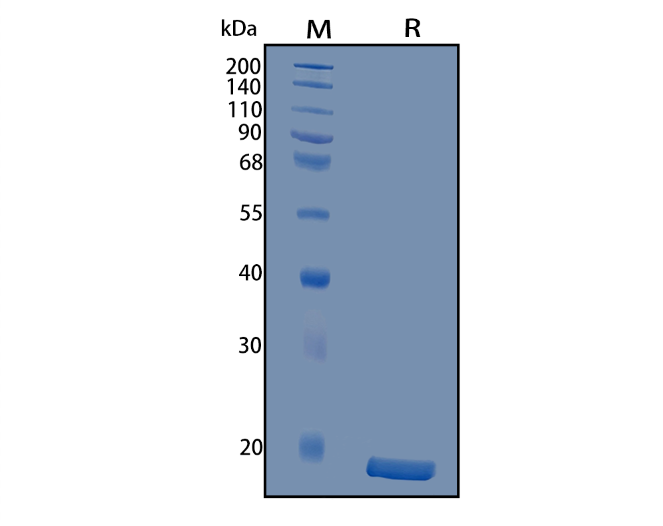
Greater than 90% as determined by SDS-PAGE.
-
Uniprot
Q9H1R3
-
Expression Region
2-596aa
-
AA Sequence
ATENGAVEL GIQNPSTDKA PKGPTGERPL AAGKDPGPPD PKKAPDPPTL KKDAKAPASE KGDGTLAQPS TSSQGPKGEG DRGGGPAEGS AGPPAALPQQ TATPETSVKK PKAEQGASGS QDPGKPRVGK KAAEGQAAAR RGSPAFLHSP SCPAIISSSE KLLAKKPPSE ASELTFEGVP MTHSPTDPRP AKAEEGKNIL AESQKEVGEK TPGQAGQAKM QGDTSRGIEF QAVPSEKSEV GQALCLTARE EDCFQILDDC PPPPAPFPHR MVELRTGNVS SEFSMNSKEA LGGGKFGAVC TCMEKATGLK LAAKVIKKQT PKDKEMVLLE IEVMNQLNHR NLIQLYAAIE TPHEIVLFME YIEGGELFER IVDEDYHLTE VDTMVFVRQI CDGILFMHKM RVLHLDLKPE NILCVNTTGH LVKIIDFGLA RRYNPNEKLK VNFGTPEFLS PEVVNYDQIS DKTDMWSMGV ITYMLLSGLS PFLGDDDTET LNNVLSGNWY FDEETFEAVS DEAKDFVSNL IVKDQRARMN AAQCLAHPWL NNLAEKAKRC NRRLKSQILL KKYLMKRRWK KNFIAVSAAN RFKKISSSGA LMALGV
-
Endotoxin
< 1.0 EU per μg protein as determined by the LAL method.
-
Form
Freeze-dried powder
-
Buffer formulation
PBS, pH7.4, containing 0.01% SKL, 1mM DTT, 5% Trehalose and Proclin300.
-
Reconstitution
Reconstitute in ddH2O to a concentration of 0.1-0.5 mg/mL. Do not vortex.
- Customization
-
Stability Test
The thermal stability is described by the loss rate. The loss rate was determined by accelerated thermal degradation test, that is, incubate the protein at 37℃ for 48h, and no obvious degradation and precipitation were observed. The loss rate isless than 8% within the expiration date under appropriate storage condition.
-
Storage & Shelf Life
Samples are stable for up to twelve months from date of receipt at -20℃ to -80℃. Store it under sterile conditions at -20℃ to -80℃. It is recommended that the protein be aliquoted for optimal storage. Avoid repeated freeze-thaw cycles.
-
Shipping
In general, recombinant proteins are supplied as lyophilized powder and shipped at ambient temperature. For bulk packages, the proteins are provided as frozen liquid and shipped with blue ice, unless otherwise requested by the customer.
Quality inspection process

Related Products
Protein Description
MYLK2 (Myosin Light Chain Kinase 2) is a serine/threonine kinase that plays a crucial role in regulating various cellular processes, including muscle contraction, cell motility, and signaling pathways associated with cell growth and differentiation. The research on MYLK2 recombinant protein has gained significant attention due to its potential implications in understanding cardiovascular diseases, smooth muscle disorders, and even tumor biology. By investigating the biochemical properties and functional mechanisms of MYLK2, researchers aim to elucidate its role in cellular signaling cascades, particularly those involving myosin light chain phosphorylation, which is essential for muscle contraction and cellular movement. Moreover, the availability of recombinant MYLK2 allows for detailed structural and functional studies, paving the way for potential therapeutic applications. Such studies could contribute to the development of targeted therapies for diseases linked to dysregulation of MYLK2 activity. Furthermore, understanding MYLK2's interactions with other proteins and its regulatory mechanisms may provide insights into novel regulatory pathways that govern cellular behavior, hence broadening our knowledge of basic biology and disease mechanisms.







