


Analytical Data
-
Gene name
DUSP9
- Application
-
Alternative Names
DUSP9;MKP4;Dual specificity Protein phosphatase 9
-
Species
Human
-
Source
E. coli
-
Tag
His tag N-Terminus
-
Purity
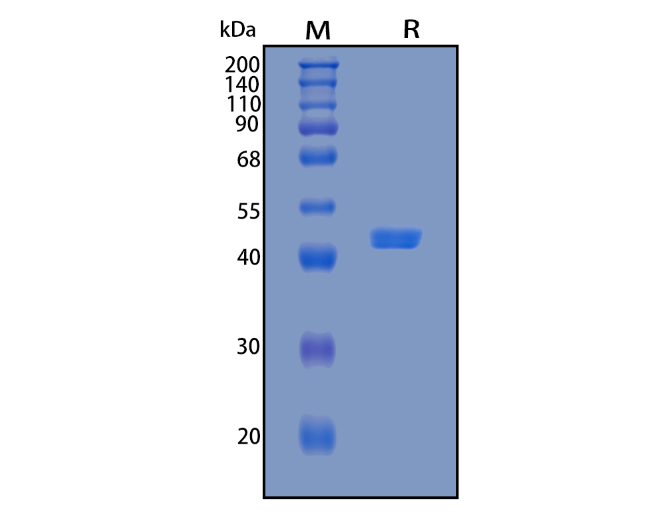
Greater than 90% as determined by SDS-PAGE.
-
Uniprot
Q99956
-
Expression Region
1-384aa
-
AA Sequence
MEGLGRSCLW LRRELSPPRP RLLLLDCRSR ELYESARIGG ALSVALPALL LRRLRRGSLS VRALLPGPPL QPPPPAPVLL YDQGGGRRRR GEAEAEAEEW EAESVLGTLL QKLREEGYLA YYLQGGFSRF QAECPHLCET SLAGRAGSSM APVPGPVPVV GLGSLCLGSD CSDAESEADR DSMSCGLDSE GATPPPVGLR ASFPVQILPN LYLGSARDSA NLESLAKLGI RYILNVTPNL PNFFEKNGDF HYKQIPISDH WSQNLSRFFP EAIEFIDEAL SQNCGVLVHC LAGVSRSVTV TVAYLMQKLH LSLNDAYDLV KRKKSNISPN FNFMGQLLDF ERSLRLEERH SQEQGSGGQA SAASNPPSFF TTPTSDGAFE LAPT
-
Endotoxin
< 1.0 EU per μg protein as determined by the LAL method.
-
Form
Freeze-dried powder
-
Buffer formulation
PBS, pH7.4, containing 0.01% SKL, 1mM DTT, 5% Trehalose and Proclin300.
-
Reconstitution
Reconstitute in ddH2O to a concentration of 0.1-0.5 mg/mL. Do not vortex.
- Customization
-
Stability Test
The thermal stability is described by the loss rate. The loss rate was determined by accelerated thermal degradation test, that is, incubate the protein at 37℃ for 48h, and no obvious degradation and precipitation were observed. The loss rate isless than 8% within the expiration date under appropriate storage condition.
-
Storage & Shelf Life
Samples are stable for up to twelve months from date of receipt at -20℃ to -80℃. Store it under sterile conditions at -20℃ to -80℃. It is recommended that the protein be aliquoted for optimal storage. Avoid repeated freeze-thaw cycles.
-
Shipping
In general, recombinant proteins are supplied as lyophilized powder and shipped at ambient temperature. For bulk packages, the proteins are provided as frozen liquid and shipped with blue ice, unless otherwise requested by the customer.
Quality inspection process

Related Products





Protein Description
DUSP9, or Dual Specificity Phosphatase 9, is a member of the dual specificity phosphatase family, which plays a critical role in cellular signaling by regulating MAPK (Mitogen-Activated Protein Kinase) pathways through dephosphorylation. The dysregulation of DUSP9 has been implicated in various diseases, including cancer, where it may influence cell proliferation, survival, and differentiation. Recent studies have highlighted DUSP9's potential as a biomarker for certain cancers and its involvement in immune responses, making it a promising target for therapeutic interventions. The development of DUSP9 recombinant protein has become a focal point for research, enabling scientists to delve into its functional mechanisms and evaluate its role in disease processes. By generating purified recombinant DUSP9, researchers can conduct biochemical assays, investigate its interactions with different signaling molecules, and explore its effects on cellular functions. Understanding how DUSP9 operates at the molecular level could yield insights into designing targeted therapies that modulate its activity, offering new avenues for cancer treatment and other related conditions.







