

Analytical Data
-
Gene name
Histone H3
-
简介
Histone H3 Protein constitutes a core element in the nucleosome, an octamer comprising H2A, H2B, H3, and H4. The assembly forms a histone octamer with one H3-H4 heterotetramer and two H2A-H2B heterodimers, serving as a molecular spool that wraps around 147 base pairs of DNA. This compact organization contributes to chromatin structure, and Histone H3, as part of this assembly, plays a crucial role in chromatin structure and gene regulation. Histone H3 Protein, Xenopus laevis (98a.a, His) is the recombinant Xenopus laevis-derived Histone H3 protein, expressed by E. coli , with tag free.
- Application
-
Alternative Names
H3c8.S; H3I; hist1h3g
-
Species
Xenopus laevis
-
Source
E. coli
-
Tag
N-6*His
-
Purity
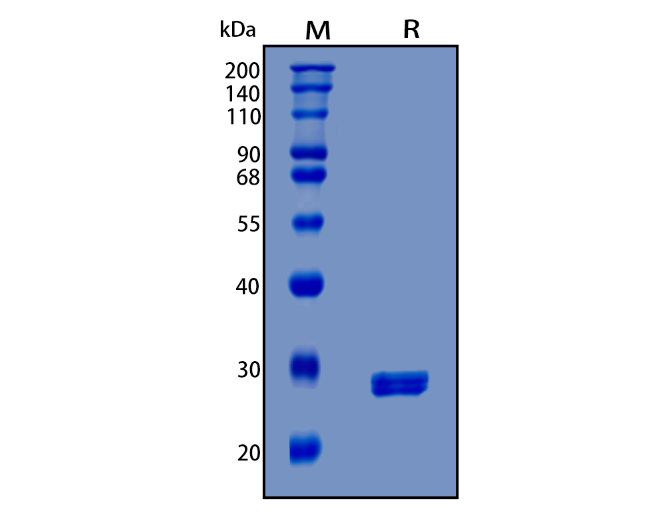
Greater than 95% as determined by SDS-PAGE.
-
Uniprot
Q92133
-
Expression Region
P39-A136
-
Protein Length
Partial
-
Molecular Weight
13 kDa
-
Endotoxin
< 1.0 EU per μg protein as determined by the LAL method.
-
Form
Freeze-dried powder
-
Buffer formulation
PBS, pH7.4, containing 0.01% SKL, 1mM DTT, 5% Trehalose and Proclin300.
-
Reconstitution
Reconstitute in ddH2O to a concentration of 0.1-0.5 mg/mL. Do not vortex.
- Customization
-
Stability Test
The thermal stability is described by the loss rate. The loss rate was determined by accelerated thermal degradation test, that is, incubate the protein at 37℃ for 48h, and no obvious degradation and precipitation were observed. The loss rate isless than 8% within the expiration date under appropriate storage condition.
-
Storage & Shelf Life
Samples are stable for up to twelve months from date of receipt at -20℃ to -80℃. Store it under sterile conditions at -20℃ to -80℃. It is recommended that the protein be aliquoted for optimal storage. Avoid repeated freeze-thaw cycles.
-
Shipping
In general, recombinant proteins are supplied as lyophilized powder and shipped at ambient temperature. For bulk packages, the proteins are provided as frozen liquid and shipped with blue ice, unless otherwise requested by the customer.
Quality inspection process

Related Products
Protein Description
Histone H3 recombinant protein has garnered significant interest in the field of molecular biology due to its critical role in chromatin structure and gene regulation. Histones, particularly H3, are fundamental components of nucleosomes, which package DNA into a compact, organized form within the nucleus of eukaryotic cells. The post-translational modifications of histone H3, such as methylation, acetylation, and phosphorylation, are known to influence gene expression patterns and are closely linked to various cellular processes, including replication, repair, and transcription. The study of recombinant Histone H3 allows researchers to explore these modifications in a controlled environment, facilitating their understanding of epigenetic mechanisms. Furthermore, aberrations in histone modifications have been associated with several diseases, including cancer, making the investigation of H3 variants and their interactions crucial for therapeutic development. By utilizing recombinant technology, scientists can produce specific histone variants for in vitro studies, enabling them to dissect the influence of particular histone modifications on chromatin dynamics and gene activity. Ultimately, this research contributes to a deeper understanding of the epigenetic landscape and its implications in health and disease.







