

Analytical Data
-
Gene name
ACAT1
-
简介
The ACAT1 protein is a key enzyme in mitochondrial beta-oxidation and plays a crucial role in breaking down fatty acids into acetyl-CoA. In the final step, ACAT1 catalyzes the thiolytic cleavage of 3-oxoacyl-CoA to generate acetyl-CoA and shortened fatty acyl-CoA. ACAT1 Protein Protein, Human (His) is the recombinant human-derived ACAT1 protein, expressed by E. coli , with N-His labeled tag.
- Application
-
Species
Human
-
Source
E. coli
-
Tag
N-10*His
-
Purity
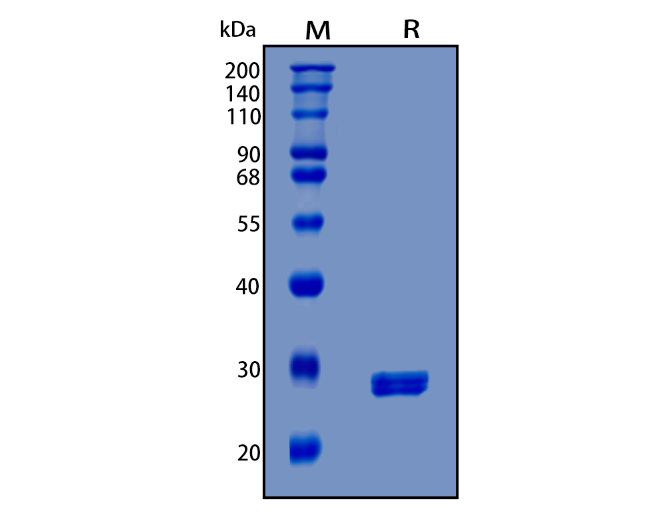
Greater than 90% as determined by SDS-PAGE.
-
Uniprot
P24752-1
-
Expression Region
V34-L427
-
Protein Length
Full Length of Isoform-1 Mature Protein
-
Endotoxin
< 1.0 EU per μg protein as determined by the LAL method.
-
Form
Freeze-dried powder
-
Buffer formulation
PBS, pH7.4, containing 0.01% SKL, 1mM DTT, 5% Trehalose and Proclin300.
-
Reconstitution
Reconstitute in ddH2O to a concentration of 0.1-0.5 mg/mL. Do not vortex.
- Customization
-
Stability Test
The thermal stability is described by the loss rate. The loss rate was determined by accelerated thermal degradation test, that is, incubate the protein at 37℃ for 48h, and no obvious degradation and precipitation were observed. The loss rate isless than 8% within the expiration date under appropriate storage condition.
-
Storage & Shelf Life
Samples are stable for up to twelve months from date of receipt at -20℃ to -80℃. Store it under sterile conditions at -20℃ to -80℃. It is recommended that the protein be aliquoted for optimal storage. Avoid repeated freeze-thaw cycles.
-
Shipping
In general, recombinant proteins are supplied as lyophilized powder and shipped at ambient temperature. For bulk packages, the proteins are provided as frozen liquid and shipped with blue ice, unless otherwise requested by the customer.
Quality inspection process

Related Products
Protein Description
ACAT1 (Acyl-CoA cholesterol acyltransferase 1) is an essential enzyme involved in cholesterol metabolism, catalyzing the formation of cholesteryl esters from free cholesterol and acyl-CoA in various tissues. Its role in lipid homeostasis makes it a critical player in the development of atherosclerosis and other lipid-related diseases. Overexpression of ACAT1 has been linked to increased cholesterol esterification, contributing to foam cell formation in arterial walls, while its inhibition has been suggested as a therapeutic strategy for cardiovascular diseases. Moreover, ACAT1 is involved in the regulation of cellular signaling pathways and inflammatory responses, making it a potential target for metabolic disorder treatments. Recent advancements in recombinant protein technology have allowed for the production of ACAT1 with enhanced stability and activity for use in biochemical assays and structural studies. Research into ACAT1 not only aims to elucidate its functional mechanisms but also explores its potential as a biomarker for disease diagnosis and prognosis. As such, investigating ACAT1 through recombinant protein studies provides insights into its physiological functions and opens avenues for innovative therapeutic approaches in treating related metabolic disorders.







