

Analytical Data
-
Gene name
PD-L1
- Application
-
Alternative Names
Programmed cell death 1 ligand 1; PD-L1; B7-H1; CD274; PDL1
-
Species
Canine
-
Source
HEK293
-
Tag
C-His
-
Purity
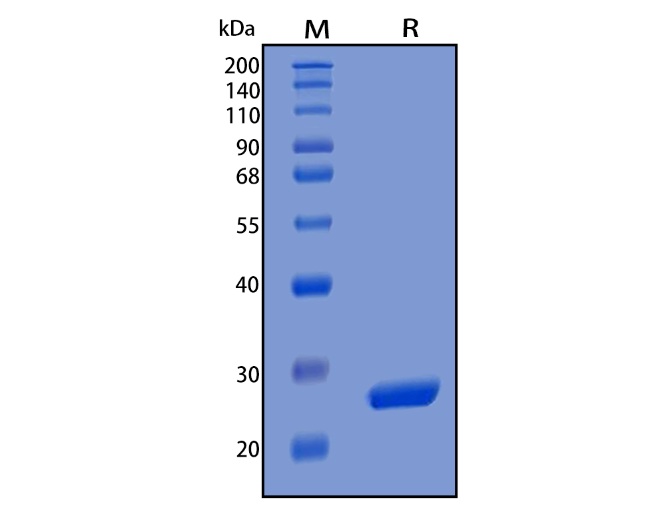
Greater than 90% as determined by SDS-PAGE.
-
Uniprot
NP_001278901.1
-
Expression Region
M1-R236
-
Protein Length
Partial
-
Molecular Weight
48.1 kDa & 41.7 kDa
-
Endotoxin
< 1.0 EU per μg protein as determined by the LAL method.
-
Form
Freeze-dried powder
-
Buffer formulation
PBS, pH7.4, containing 0.01% SKL, 1mM DTT, 5% Trehalose and Proclin300.
-
Reconstitution
Reconstitute in ddH2O to a concentration of 0.1-0.5 mg/mL. Do not vortex.
- Customization
-
Stability Test
The thermal stability is described by the loss rate. The loss rate was determined by accelerated thermal degradation test, that is, incubate the protein at 37℃ for 48h, and no obvious degradation and precipitation were observed. The loss rate isless than 8% within the expiration date under appropriate storage condition.
-
Storage & Shelf Life
Samples are stable for up to twelve months from date of receipt at -20℃ to -80℃. Store it under sterile conditions at -20℃ to -80℃. It is recommended that the protein be aliquoted for optimal storage. Avoid repeated freeze-thaw cycles.
-
Shipping
In general, recombinant proteins are supplied as lyophilized powder and shipped at ambient temperature. For bulk packages, the proteins are provided as frozen liquid and shipped with blue ice, unless otherwise requested by the customer.
Quality inspection process

Related Products
Protein Description
Programmed death-ligand 1 (PD-L1) is a crucial immune checkpoint protein involved in regulating the immune system's response to cancer. It functions by binding to its receptor, PD-1, on T cells, thereby inhibiting T cell activation and allowing tumors to escape immune surveillance. The overexpression of PD-L1 in various cancers has been linked to poor prognosis, making it a significant target for cancer immunotherapy. In recent years, the development of PD-L1 recombinant proteins has gained attention for their potential to enhance immune responses against tumors. Researchers have focused on producing these proteins through recombinant DNA technology, enabling the generation of large quantities of pure PD-L1 for both therapeutic and diagnostic applications. These recombinant proteins can be used to study PD-L1 interactions in vitro, assess immune responses, and facilitate the development of PD-L1-targeted therapies, including monoclonal antibodies and vaccines. Additionally, understanding the structural and functional characteristics of PD-L1 can provide insights into the mechanisms of immune evasion in cancer. As a result, PD-L1 recombinant proteins hold promise not only for advancing cancer treatment strategies but also for improving our understanding of the intricate relationship between cancer and the immune system.







