

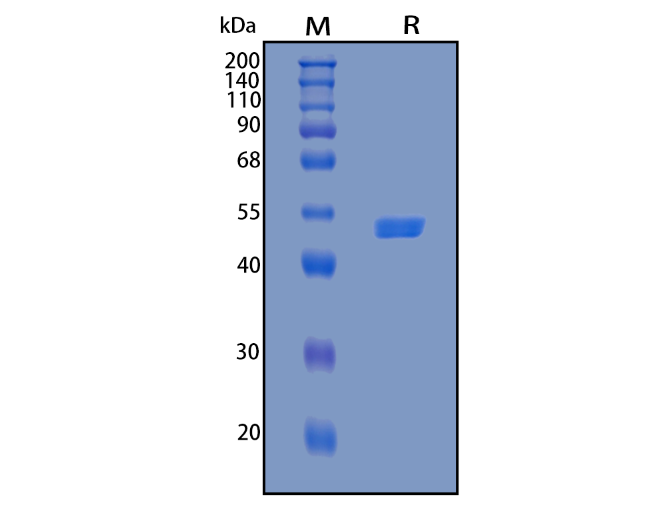
Analytical Data
-
Gene name
PTEN
- Application
-
Alternative Names
BZS; MHAM; MMAC1; PTEN1; TEP1; Mutated In Multiple Advanced Cancers 1; Phosphatidylinositol 3,4,5-trisphosphate 3-phosphatase and dual-specificity protein phosphatase PTEN
-
Species
Human
-
Source
E. coli
-
Tag
N-terminal His-Tag
-
Purity
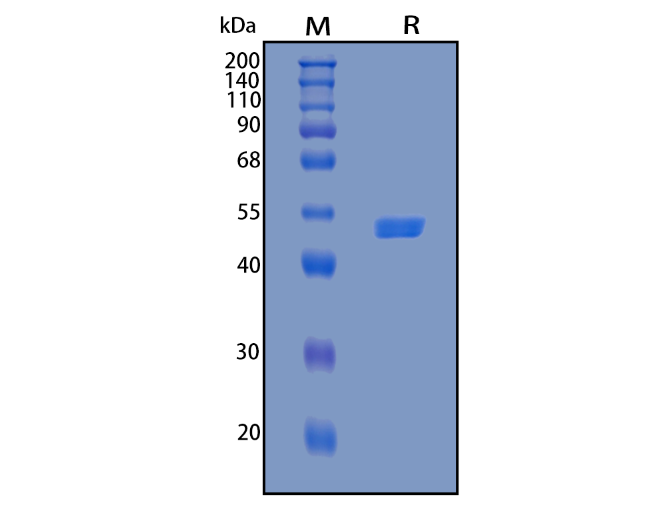
Greater than 90% as determined by SDS-PAGE.
-
Uniprot
P60484
-
Expression Region
2~403aa
-
AA Sequence
TAIIKEIVSRNKRRYQEDGFDLDLTYIYPNIIAMGFPAERLEGVYRNNIDDVVR FLDSKHKNHYKIYNLCAERHYDTAKFNCRVAQYPFEDHNPPQLELIKPFCEDLD QWLSEDDNHVAAIHCKAGKGRTGVMICAYLLHRGKFLKAQEALDFYGEVRTRDK KGVTIPSQRRYVYYYSYLLKNHLDYRPVALLFHKMMFETIPMFSGGTCNPQFVV CQLKVKIYSSNSGPTRREDKFMYFEFPQPLPVCGDIKVEFFHKQNKMLKKDKMF HFWVNTFFIPGPEETSEKVENGSLCDQEIDSICSIERADNDKEYLVLTLTKNDL DKANKDKANRYFSPNFKVKLYFTKTVEEPSNPEASSSTSVTPDVSDNEPDHYRY SDTTDSDPENEPFDEDQHTQITKV
-
Molecular Weight
48.6kDa
-
Endotoxin
< 1.0 EU per μg protein as determined by the LAL method.
-
Form
Freeze-dried powder
-
Buffer formulation
PBS, pH7.4, containing 0.01% SKL, 1mM DTT, 5% Trehalose and Proclin300.
-
Reconstitution
Reconstitute in ddH2O to a concentration of 0.1-0.5 mg/mL. Do not vortex.
- Customization
-
Stability Test
The thermal stability is described by the loss rate. The loss rate was determined by accelerated thermal degradation test, that is, incubate the protein at 37℃ for 48h, and no obvious degradation and precipitation were observed. The loss rate isless than 8% within the expiration date under appropriate storage condition.
-
Storage & Shelf Life
Samples are stable for up to twelve months from date of receipt at -20℃ to -80℃. Store it under sterile conditions at -20℃ to -80℃. It is recommended that the protein be aliquoted for optimal storage. Avoid repeated freeze-thaw cycles.
-
Shipping
In general, recombinant proteins are supplied as lyophilized powder and shipped at ambient temperature. For bulk packages, the proteins are provided as frozen liquid and shipped with blue ice, unless otherwise requested by the customer.
Quality inspection process

Related Products






Identification
Protein Description
PTEN (Phosphatase and Tensin Homolog) is a critical tumor suppressor protein that plays a pivotal role in regulating cellular processes, including cell growth, survival, and proliferation, primarily through its lipid phosphatase activity that dephosphorylates phosphatidylinositol (3,4,5)-trisphosphate (PIP3). Mutations or deletions of the PTEN gene are commonly associated with various cancers, leading to the hyperactivation of the PI3K/Akt signaling pathway, which contributes to tumorigenesis. Due to its significant role in cancer biology, the study of PTEN has garnered considerable interest, particularly in understanding its functional mechanisms and potential as a therapeutic target. Researchers have focused on recombinant protein techniques to produce and characterize the PTEN protein, enabling the exploration of its structure-function relationships, subcellular localization, and interaction with other signaling molecules. This research aims to elucidate the dynamic role of PTEN in cellular signaling pathways and its implications in cancer development and progression. Furthermore, the development of PTEN-based therapies could pave the way for novel treatment strategies, particularly in tumors exhibiting PTEN deficiency. Current investigations are also examining the impact of PTEN reconstitution in cancer models, aiming to reverse the oncogenic effects caused by the loss of PTEN activity and enhance the efficacy of existing cancer therapeutics. Overall, the ongoing study of recombinant PTEN is crucial for uncovering its therapeutic potential and advancing our understanding of cancer biology.







