

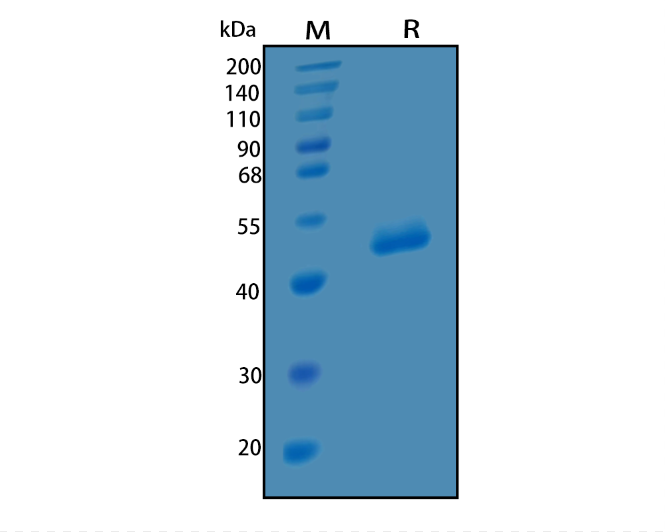
Analytical Data
-
Gene name
TLR4
- Application
-
Alternative Names
TLR4;Toll-like receptor 4
-
Species
Human
-
Source
E. coli
-
Tag
His tag N-Terminus
-
Purity
Greater than 90% as determined by SDS-PAGE.
-
Uniprot
O00206
-
Expression Region
326-634aa
-
AA Sequence
FSYNFGWQHLELVNCKFGQFPTLKLKSLKRLTFTSNKGGNAFSEVDLPSLEFLD LSRNGLSFKGCCSQSDFGTTSLKYLDLSFNGVITMSSNFLGLEQLEHLDFQHSN LKQMSEFSVFLSLRNLIYLDISHTHTRVAFNGIFNGLSSLEVLKMAGNSFQENF LPDIFTELRNLTFLDLSQCQLEQLSPTAFNSLSSLQVLNMSHNNFFSLDTFPYK CLNSLQVLDYSLNHIMTSKKQELQHFPSSLAFLNLTQNDFACTCEHQSFLQWIK DQRQLLVEVERMECATPSDKQGMPVLSLNITCQMNKTII
-
Molecular Weight
42.0kDa
-
Endotoxin
< 1.0 EU per μg protein as determined by the LAL method.
-
Form
Freeze-dried powder
-
Buffer formulation
PBS, pH7.4, containing 0.01% SKL, 1mM DTT, 5% Trehalose and Proclin300.
-
Reconstitution
Reconstitute in ddH2O to a concentration of 0.1-0.5 mg/mL. Do not vortex.
- Customization
-
Stability Test
The thermal stability is described by the loss rate. The loss rate was determined by accelerated thermal degradation test, that is, incubate the protein at 37℃ for 48h, and no obvious degradation and precipitation were observed. The loss rate isless than 8% within the expiration date under appropriate storage condition.
-
Storage & Shelf Life
Samples are stable for up to twelve months from date of receipt at -20℃ to -80℃. Store it under sterile conditions at -20℃ to -80℃. It is recommended that the protein be aliquoted for optimal storage. Avoid repeated freeze-thaw cycles.
-
Shipping
In general, recombinant proteins are supplied as lyophilized powder and shipped at ambient temperature. For bulk packages, the proteins are provided as frozen liquid and shipped with blue ice, unless otherwise requested by the customer.
Quality inspection process

Related Products
Identification
Protein Description
Toll-like receptor 4 (TLR4) is a crucial component of the innate immune system, playing a significant role in recognizing pathogen-associated molecular patterns (PAMPs) and initiating immune responses. The study of TLR4 and its recombinant protein has garnered considerable attention due to its involvement in various infectious and inflammatory diseases. TLR4 recognizes lipopolysaccharides (LPS) from Gram-negative bacteria, leading to the activation of downstream signaling pathways that elevate the expression of pro-inflammatory cytokines, chemokines, and other immune mediators. Dysregulation of TLR4 signaling is associated with numerous pathological conditions, including sepsis, autoimmune disorders, and chronic inflammation. Recombinant TLR4 proteins have emerged as valuable tools for research, allowing scientists to explore its structure-function relationship, ligand interactions, and signaling mechanisms in a controlled environment. Furthermore, the generation of TLR4 recombinant proteins facilitates the development of therapeutic strategies aimed at modulating TLR4 activity, either by enhancing its function to boost immune responses or by inhibiting it in conditions of excessive inflammation. This dual potential positions TLR4 as a key target for new interventions in treating infections and inflammatory diseases, thereby highlighting the importance of continued research into its recombinant forms.







