

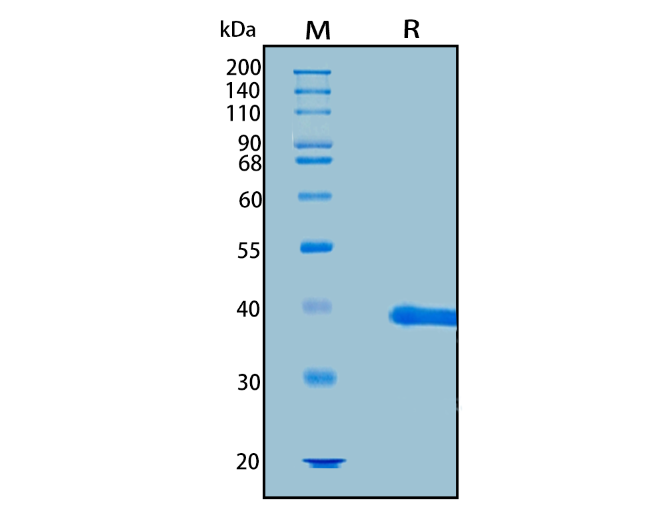
Analytical Data
-
Gene name
ACE
- Application
-
Alternative Names
ACE;DCP;DCP1;Angiotensin-converting enzyme
-
Species
Human
-
Source
E. coli
-
Tag
N-terminal His Tag
-
Purity
Greater than 90% as determined by SDS-PAGE.
-
Uniprot
P12821
-
Expression Region
30-336aa
-
AA Sequence
LDPGLQPGNFSADEAGAQLFAQSYNSSAEQVLFQSVAASWAHDTNITAENARRQ EEAALLSQEFAEAWGQKAKELYEPIWQNFTDPQLRRIIGAVRTLGSANLPLAKR QQYNALLSNMSRIYSTAKVCLPNKTATCWSLDPDLTNILASSRSYAMLLFAWEG WHNAAGIPLKPLYEDFTALSNEAYKQDGFTDTGAYWRSWYNSPTFEDDLEHLYQ QLEPLYLNLHAFVRRALHRRYGDRYINLRGPIPAHLLGDMWAQSWENIYDMVVP FPDKPNLDVTSTMLQQGWNATHMFRVAEEFFTSLELS
-
Molecular Weight
38.4kDa
-
Endotoxin
< 1.0 EU per μg protein as determined by the LAL method.
-
Form
Freeze-dried powder
-
Buffer formulation
PBS, pH7.4, containing 0.01% SKL, 1mM DTT, 5% Trehalose and Proclin300.
-
Reconstitution
Reconstitute in ddH2O to a concentration of 0.1-0.5 mg/mL. Do not vortex.
- Customization
-
Stability Test
The thermal stability is described by the loss rate. The loss rate was determined by accelerated thermal degradation test, that is, incubate the protein at 37℃ for 48h, and no obvious degradation and precipitation were observed. The loss rate isless than 8% within the expiration date under appropriate storage condition.
-
Storage & Shelf Life
Samples are stable for up to twelve months from date of receipt at -20℃ to -80℃. Store it under sterile conditions at -20℃ to -80℃. It is recommended that the protein be aliquoted for optimal storage. Avoid repeated freeze-thaw cycles.
-
Shipping
In general, recombinant proteins are supplied as lyophilized powder and shipped at ambient temperature. For bulk packages, the proteins are provided as frozen liquid and shipped with blue ice, unless otherwise requested by the customer.
Quality inspection process

Related Products
Identification
Protein Description
The study of ACE (angiotensin-converting enzyme) recombinant proteins has gained significant traction due to the pivotal role of ACE in the renin-angiotensin system, which regulates blood pressure and fluid balance. Discovered in the 1970s, ACE converts angiotensin I into the active vasoconstrictor angiotensin II, thus influencing cardiovascular function and homeostasis. Abnormal ACE activity has been linked to various health conditions, including hypertension, heart failure, and diabetic complications. Researchers have increasingly focused on ACE recombinant proteins to better understand its structure and function, as well as to explore therapeutic interventions. The ability to produce ACE in a recombinant form allows for detailed studies of its enzymatic activity, substrate specificity, and potential inhibitors, which are critical for drug development. Furthermore, recombinant ACE proteins can be utilized in diagnostic assays and in the characterization of angiotensin peptides, enhancing our understanding of their physiological and pathophysiological roles. The emergence of biotechnological tools and techniques has propelled the advancement of ACE studies, facilitating the development of novel ACE-targeted therapies and improving our understanding of cardiovascular diseases on a molecular level. This research not only aims to optimize treatment strategies for existing cardiovascular disorders but also holds promise for innovative approaches to preventive medicine and personalized healthcare solutions.







