

Analytical Data
-
Gene name
gyrB
- Application
-
Alternative Names
gyrB; DNA gyrase subunit B; Type IIA topoisomerase subunit GyrB
-
Species
E.coli
-
Source
E. coli
-
Tag
N-6*His
-
Purity
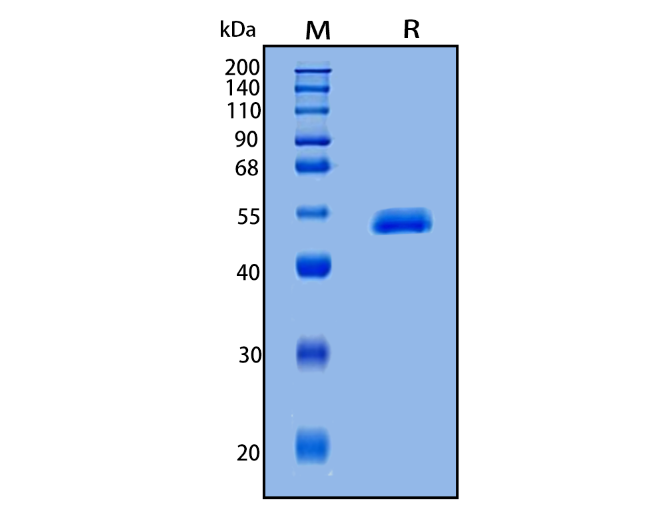
Greater than 90% as determined by SDS-PAGE.
-
Uniprot
P0AES6
-
Expression Region
S2-T392, Y5S, N198D
-
Protein Length
Partial
-
Endotoxin
< 1.0 EU per μg protein as determined by the LAL method.
-
Form
Freeze-dried powder
-
Buffer formulation
PBS, pH7.4, containing 0.01% SKL, 1mM DTT, 5% Trehalose and Proclin300.
-
Reconstitution
Reconstitute in ddH2O to a concentration of 0.1-0.5 mg/mL. Do not vortex.
- Customization
-
Stability Test
The thermal stability is described by the loss rate. The loss rate was determined by accelerated thermal degradation test, that is, incubate the protein at 37℃ for 48h, and no obvious degradation and precipitation were observed. The loss rate isless than 8% within the expiration date under appropriate storage condition.
-
Storage & Shelf Life
Samples are stable for up to twelve months from date of receipt at -20℃ to -80℃. Store it under sterile conditions at -20℃ to -80℃. It is recommended that the protein be aliquoted for optimal storage. Avoid repeated freeze-thaw cycles.
-
Shipping
In general, recombinant proteins are supplied as lyophilized powder and shipped at ambient temperature. For bulk packages, the proteins are provided as frozen liquid and shipped with blue ice, unless otherwise requested by the customer.
Quality inspection process

Related Products
Protein Description
GyrB is a crucial component of the DNA gyrase complex, an essential enzyme that introduces negative supercoils into DNA, facilitating various cellular processes such as replication, transcription, and repair. Research on GyrB is particularly significant due to its role in bacterial survival and its potential as a target for antibiotic development. The emergence of antibiotic-resistant bacterial strains has intensified interest in GyrB, as inhibiting its function could disrupt bacterial proliferation. Studies have shown that mutations in gyrB can lead to resistance against commonly used fluoroquinolone antibiotics, making it essential to understand its structure and function. Through recombinant protein techniques, researchers can produce GyrB in significant quantities for biochemical characterization, enabling detailed studies on its mechanism and interactions with other proteins. This research not only advances our understanding of bacterial DNA metabolism but also aids in the discovery of novel inhibitors that could serve as therapeutic agents against resistant infections. Overall, GyrB recombinant protein studies hold promise for innovative approaches to combat bacterial resistance and improve antibiotic efficacy.







