

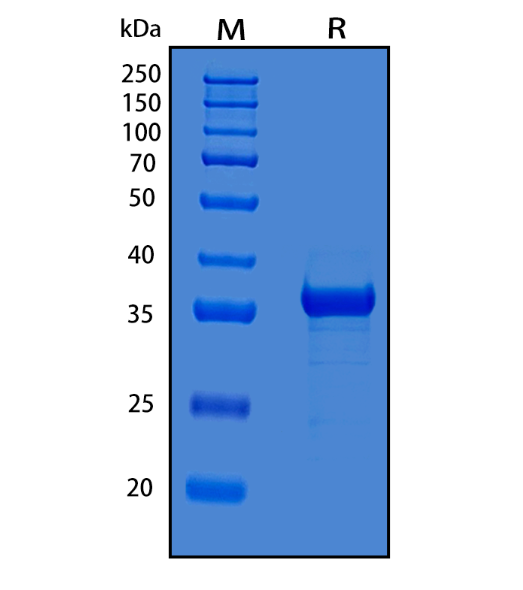
Analytical Data
-
Gene name
Fibronectin
-
简介
Fibronectin binds collagen, fibrin, heparin, DNA, and actin. It is involved in cell adhesion, motility, opsonization, wound healing and maintenance of cell shape. Fibronectin Protein, Human is the recombinant human-derived Fibronectin protein, expressed by E. coli, with tag free.
- Application
-
Biological Activity
1.Measured by its ability to support cell attachment and spreading when used as a substratum for cell culture. The ED50 for this effect is ≤ 385.7 ng/mL. 2.Measured by the ability of the immobilized protein to support the adhesion of B16-F1 mouse melanoma cells. The ED50 for this effect is ≤182.9 ng/mL, corresponding to a specific activity is ≥5.467×10³ units/mg. Measured by the ability of the immobilized protein to support the adhesion of B16-F1 mouse melanoma cells. The ED50 for this effect is 124.5 ng/mL, corresponding to a specific activity is 8.03×10³ units/mg.
-
Alternative Names
NovoNectin; Fibronectin; FN; Cold-insoluble globulin; CIG; FN; Fibronectin 1
-
Species
Human
-
Source
E. coli
-
Tag
Tag Free
-
Purity
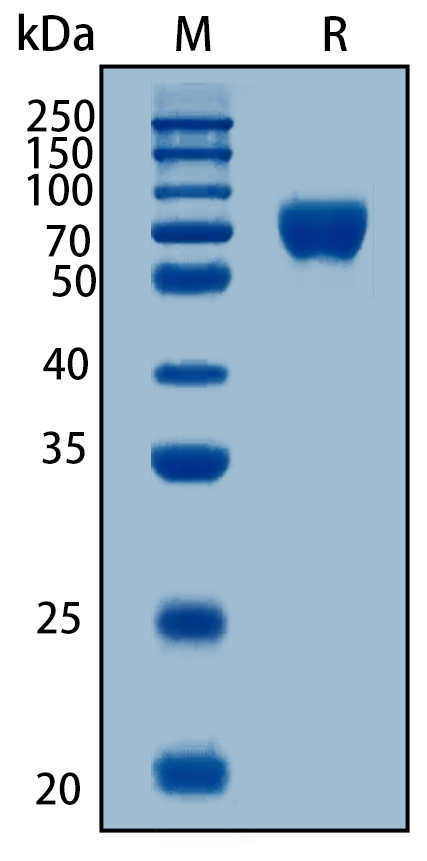
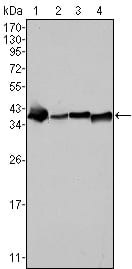
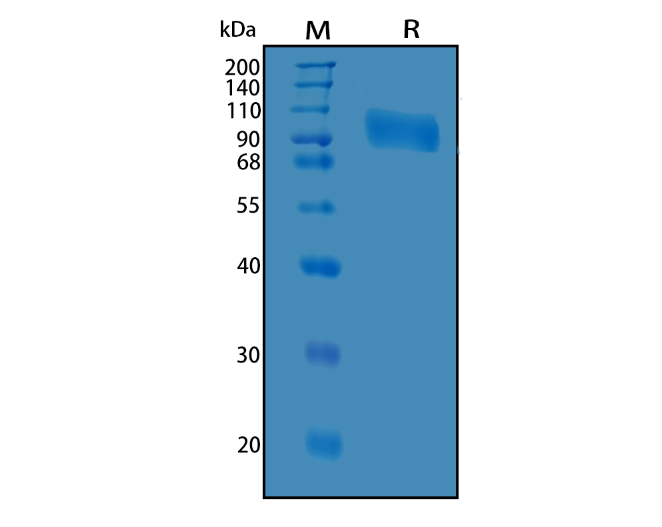
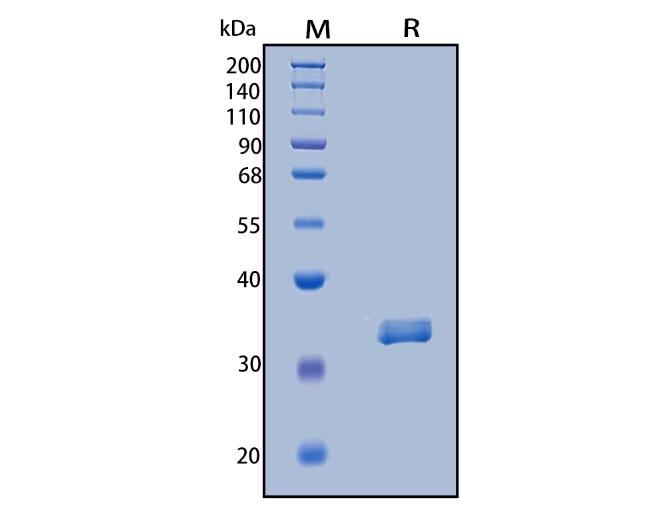
Greater than 95% as determined by SDS-PAGE.
-
Uniprot
P02751-1
-
Expression Region
P02751-1 (P1270-S1546&A1721-T2016)
-
AA Sequence
PTDLRFTNIGPDTMRVTWAPPPSIDLTNFLVRYSPVKNEEDVAELSISPSDNAVVLTNLLPGTEYVVSVSSVYEQHESTPLRGRQKTGLDSPTGIDFSDITANSFTVHWIAPRATITGYRIRHHPEHFSGRPREDRVPHSRNSITLTNLTPGTEYVVSIVALNGREESPLLIGQQSTVSDVPRDLEVVAATPTSLLISWDAPAVTVRYYRITYGETGGNSPVQEFTVPGSKSTATISGLKPGVDYTITVYAVTGRGDSPASSKPISINYRTEIDKPS&AIPAPTDLKFTQVTPTSLSAQWTPPNVQLTGYRVRVTPKEKTGPMKEINLAPDSSSVVVSGLMVATKYEVSVYALKDTLTSRPAQGVVTTLENVSPPRRARVTDATETTITISWRTKTETITGFQVDAVPANGQTPIQRTIKPDVRSYTITGLQPGTDYKIYLYTLNDNARSSPVVIDASTAIDAPSNLRFLATTPNSLLVSWQPPRARITGYIIKYEKPGSPPREVVPRPRPGVTEATITGLEPGTEYTIYVIALKNNQKSEPLIGRKKTDELPQLVTLPHPNLHGPEILDVPST
-
Protein Length
Partial
-
Molecular Weight
63 kDa
-
Endotoxin
< 1.0 EU per μg protein as determined by the LAL method.
-
Form
Freeze-dried powder
-
Buffer formulation
PBS, pH7.4, containing 0.01% SKL, 1mM DTT, 5% Trehalose and Proclin300.
-
Reconstitution
Reconstitute in ddH2O to a concentration of 0.1-0.5 mg/mL. Do not vortex.
- Customization
-
Stability Test
The thermal stability is described by the loss rate. The loss rate was determined by accelerated thermal degradation test, that is, incubate the protein at 37℃ for 48h, and no obvious degradation and precipitation were observed. The loss rate isless than 8% within the expiration date under appropriate storage condition.
-
Storage & Shelf Life
Samples are stable for up to twelve months from date of receipt at -20℃ to -80℃. Store it under sterile conditions at -20℃ to -80℃. It is recommended that the protein be aliquoted for optimal storage. Avoid repeated freeze-thaw cycles.
-
Shipping
In general, recombinant proteins are supplied as lyophilized powder and shipped at ambient temperature. For bulk packages, the proteins are provided as frozen liquid and shipped with blue ice, unless otherwise requested by the customer.
Quality inspection process

Related Products
Protein Description
Fibronectin is a glycoprotein that plays a critical role in various cellular processes, including cell adhesion, proliferation, differentiation, and wound healing. It exists in multiple isoforms due to alternative splicing and is predominantly found in the extracellular matrix. Research involving recombinant fibronectin proteins has gained significant traction due to their potential applications in biotechnology and medicine. These recombinant proteins can be engineered to enhance their functionality, facilitating studies on their role in cell-matrix interactions and the mechanics of tissue repair. Additionally, due to their ability to scaffold cells and influence signaling pathways, recombinant fibronectin is being explored for use in tissue engineering, regenerative medicine, and targeted drug delivery systems. The production of fibronectin in various expression systems, such as bacteria, yeast, or mammalian cells, has enabled researchers to obtain large quantities of pure protein for experimental purposes. Continued investigation into the structure-function relationship of fibronectin, along with advances in protein engineering techniques, is poised to unlock new therapeutic strategies for conditions where fibronectin's functions or expression are disrupted, such as in cancer metastasis or fibrotic diseases. Thus, recombinant fibronectin holds promise not only as a fundamental tool for studying biological processes but also as a versatile component in the development of innovative medical treatments.







